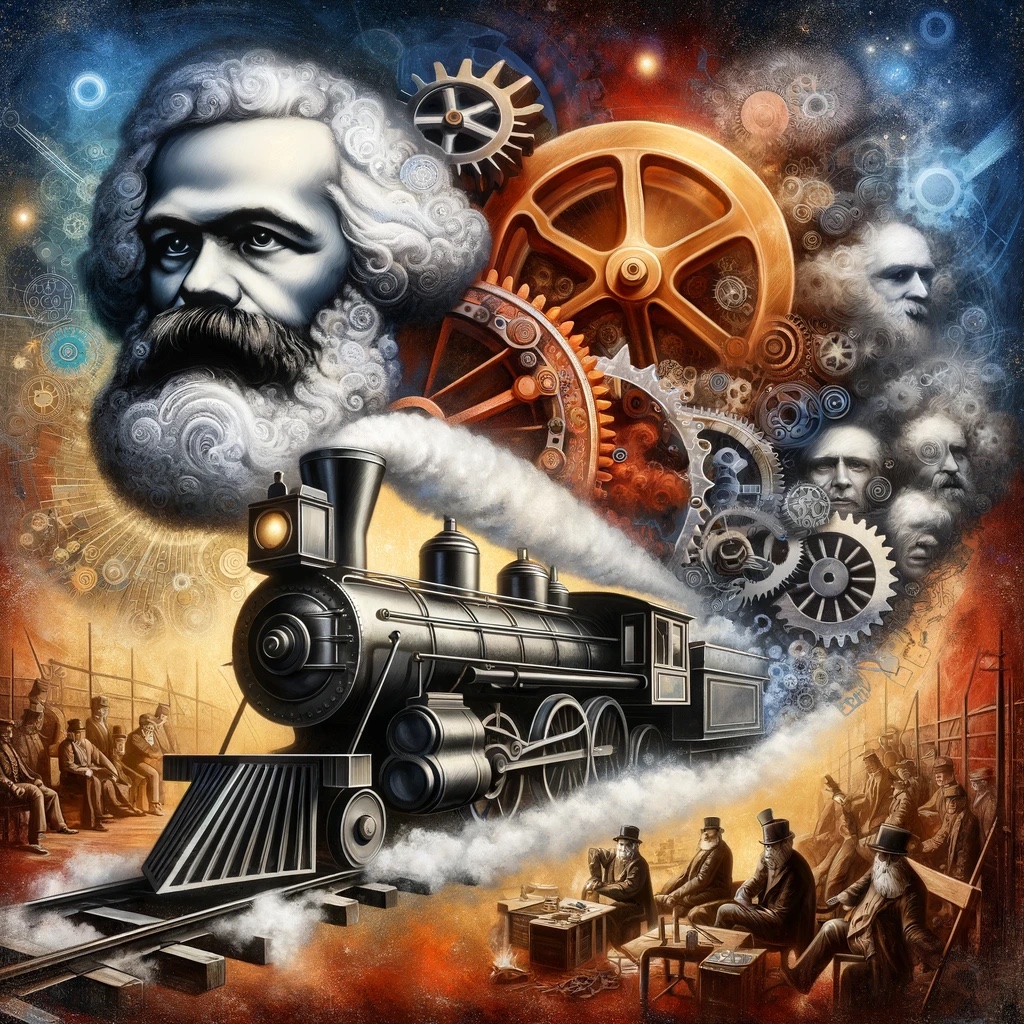
In the realm of historical inquiry, the interplay between technology and human thought presents a fascinating landscape. This correlation, especially notable in the theories of Karl Marx and Sigmund Freud, suggests a unique reflection of contemporary technological advancements on intellectual paradigms.
The Era of the Steam Engine
The 19th century witnessed the rise of the steam engine, a groundbreaking technological marvel that revolutionized industries and daily life. It was an era marked by rapid industrialization and profound social change. This technological leap was not just a physical phenomenon; it also catalyzed a shift in thought processes and societal structures.
Marx’s Class Struggle and the Pressure of Exploitation
Karl Marx’s theory of class struggle, a cornerstone of Marxist ideology, postulates that society’s history is shaped by the conflicts between different social classes. Interestingly, this theory can be metaphorically linked to the mechanics of a steam engine. Just as the steam engine operates under high-pressure conditions to produce motion, Marx viewed societal progress as driven by the pressures of exploitation and class conflict. The relentless struggle between the bourgeoisie and the proletariat, much like the steam pushing against the engine’s pistons, propels societal change.
Freud’s Psychoanalysis and the Steam of the Subconscious
Similarly, Sigmund Freud’s hypothesis on the subconscious mind draws an intriguing parallel. Freud suggested that the human psyche is layered with conscious and unconscious elements, with the latter exerting a significant yet covert influence on behavior. This can be likened to the steam engine’s hidden, yet powerful, steam pressure. Freud’s depiction of repressed sexual and aggressive instincts resonates with the notion of steam building up pressure within an engine, eventually needing release.
Technological Determinism: The Framework
These metaphors align with the concept of ‘technological determinism’, a theory suggesting that societal development is fundamentally shaped by technological innovation. This perspective posits that the prevalent technologies of an era can influence not only the material conditions of society but also the intellectual and theoretical frameworks of that period.
Reflections and Contemporary Relevance
The parallels between Marx and Freud’s theories and the steam engine offer a thought-provoking perspective on how our intellectual landscape might be influenced by the dominant technologies of our times. Just as the steam engine symbolized power, pressure, and transformation in the 19th century, today’s digital and information technologies might be shaping contemporary thought in ways we are yet to fully comprehend.
Conclusion
In conclusion, the exploration of the symbiotic relationship between technology and thought, as exemplified by the theories of Marx and Freud in the context of the steam engine era, offers a rich avenue for understanding how our technological environment can shape our intellectual and cultural landscapes. As we advance into new technological frontiers, it becomes increasingly important to consider how these advancements might be silently sculpting our collective consciousness and societal structures.
 Atsushi's Life in Korea