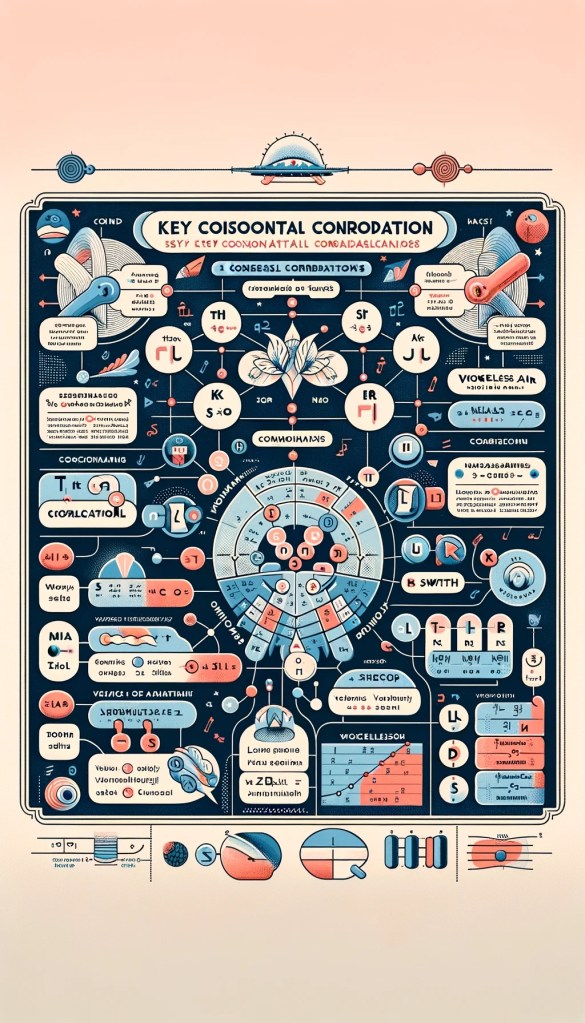
In the fascinating world of linguistics, one of the most intriguing aspects is the study of consonantal correlations and switch patterns. These patterns not only reveal the nuances of language structure but also shed light on the evolution and interconnectedness of languages. Let’s delve into some of these intriguing patterns.
The Basics: Voice and Place of Articulation
Before exploring specific correlations, it’s essential to understand two key concepts in phonetics: voicing and place of articulation. Voicing differentiates between sounds produced with vocal cord vibration (voiced sounds) and those without (voiceless sounds). Place of articulation, on the other hand, refers to where in the vocal tract a sound is produced – lips, teeth, throat, etc.
Common Consonantal Correlations
- T and Th: This is a classic example seen in English, contrasting the voiced dental fricative [θ] in “this” and the voiceless alveolar plosive [t] in “tin.” The subtle difference in voicing and place of articulation significantly changes the meaning.
- K and G: These are velar sounds, but while ‘k’ is voiceless, ‘g’ is voiced. This pattern is common across many languages, distinguishing words through voicing.
- S and Z: Again, a pair of a voiceless (s) and a voiced (z) sound, both articulated at the alveolar ridge.
- L and R Switch: In some languages, particularly in East Asian languages, there’s a fluid interchange between ‘l’ and ‘r’ sounds, which can be challenging for language learners.
- Voiceless and Voiced Pairs: Across languages, there are standard pairings of voiceless and voiced consonants, such as p/b, t/d, k/g. This pairing is fundamental in phonology, often used to differentiate words.
- Nasal and Stop Correlations: Nasal sounds like ‘m’, ‘n’, and ‘ŋ’ often correlate with their stop counterparts, like ‘p/b’, ‘t/d’, ‘k/g’. This relationship can be observed in how nasal sounds influence the pronunciation of subsequent sounds.
The Impact of These Correlations
Understanding these correlations is crucial for several reasons. Firstly, they are key in phonological studies, helping linguists understand how languages evolve and influence each other. For language learners, these patterns are critical in mastering pronunciation and comprehension. Moreover, these patterns often reflect historical and cultural connections between languages, providing insights into the migration and interaction of different language-speaking groups.
Conclusion
Consonantal correlations and switch patterns are more than just a linguistic curiosity; they are windows into the history, structure, and evolution of languages. By studying these patterns, linguists can trace the paths of human communication across time and space, offering us a deeper understanding of our linguistic roots and connections. As we continue to explore these patterns, we gain a greater appreciation for the complexity and beauty of human language.
 Atsushi's Life in Korea