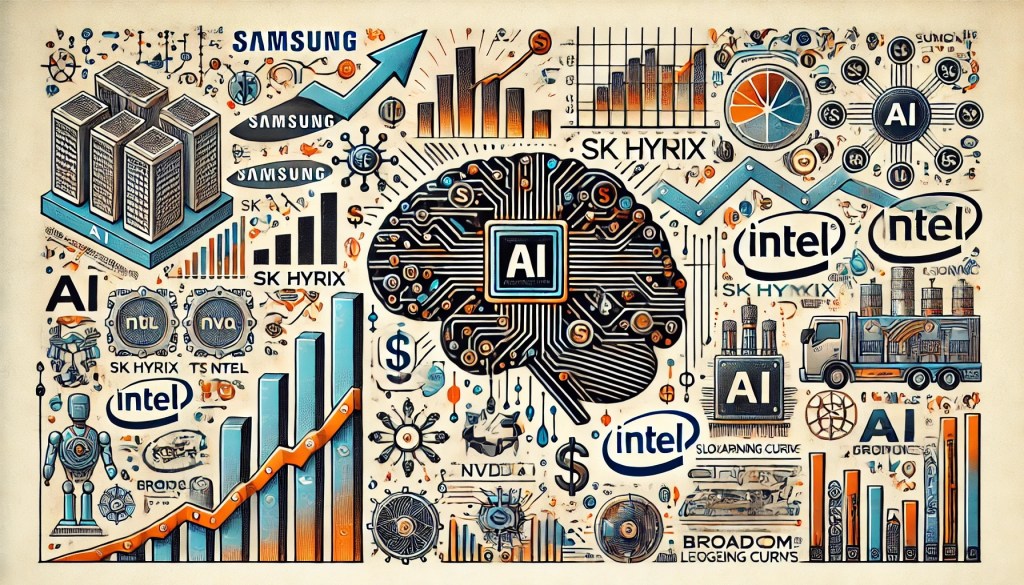
1. The Current State and Challenges of AI-Related Stocks
Recently, AI (artificial intelligence) related stocks have been a significant topic of interest, with various concerns and challenges surfacing. Over the past 2-3 years, the AI industry has experienced rapid growth, with many companies actively investing in AI technology. However, recently, questions have been raised about the profitability of these investments, leading to a decline in AI, semiconductor, and power-related stocks both domestically and internationally.
Samsung Electronics’ stock price fell by 10.30%, and SK Hynix dropped by 9.87%. Additionally, companies related to AI power supply, such as content and cable companies, have also recorded significant declines. In the US market, major AI-related companies like NVIDIA, Amazon, and Microsoft have seen their stock prices fall as well.
2. Intel’s Performance and the Profitability Issue in the AI Industry
Intel’s stock price dropped by 26.06%, which also caught attention. Intel CEO Pat Gelsinger stated during their performance announcement that they have not yet achieved complete profitability regarding major AI trends, highlighting the high costs and low profit margins as significant issues.
Moreover, the annual salary for an OpenAI engineer is about 2 billion won, which adds to the concern. With the depletion of significant learning data and the difficulties in achieving future profitability, the challenges continue to mount.
3. Stagnant AI Demand and Delayed Digital Transformation (DX)
The digital transformation (DX), which is crucial for AI adoption, is still ongoing, with many companies working towards it. However, due to economic downturn concerns, it is challenging to make quick decisions on large-scale AI transitions.
On the other hand, the rapid emergence of innovative AI services and the depletion of data necessary for AI learning are also concerning. This depletion could slow down AI learning speeds, potentially hindering technological advancements.
4. Investment Strategies and Future Outlook
Experts emphasize the need to discern between valuable and less valuable AI-related stocks carefully. They suggest avoiding stocks that have risen sharply due to high expectations and focusing on core companies instead. Companies at the center of AI hardware and semiconductor fields, such as NVIDIA, TSMC, and Broadcom, are considered valuable for a strategic approach involving purchasing during price corrections.
There is also growth potential for domestic AI-related equipment and infrastructure companies. Major high-tech companies continue to expand their AI equipment investments, and high-bandwidth memory (HBM) related stocks may see some rebound. AI software companies that pursue a ‘focused strategy’ could maintain growth by providing services to security-conscious government and public institutions and by targeting emerging markets in Southeast Asia.
5. Conclusion
The AI industry faces numerous challenges and growth opportunities. It is essential to monitor technological advancements and market trends carefully while establishing a sound investment strategy. Prioritizing investments in core companies and aiming for efficient growth are crucial. Keeping a close eye on the AI industry’s developments and making informed decisions will be key moving forward.
 Atsushi's Life in Korea