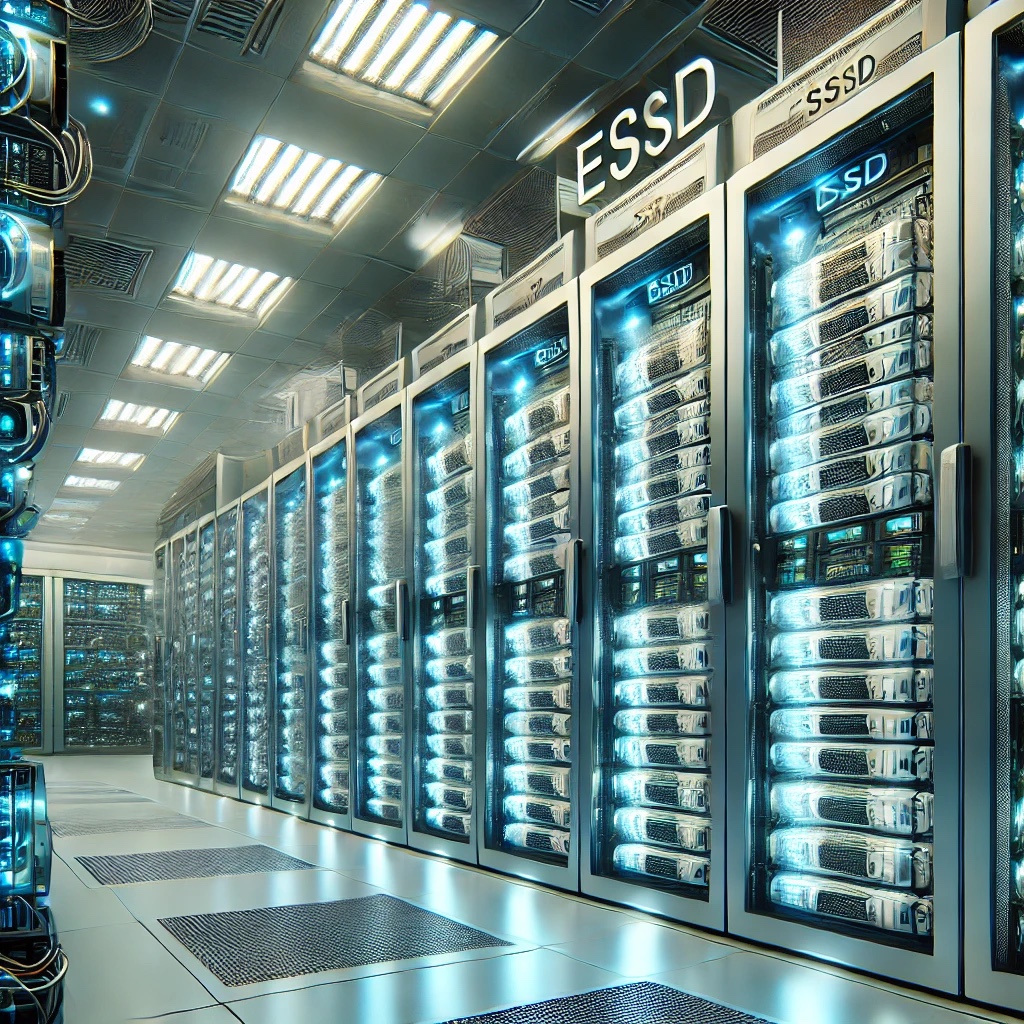
Introduction: Why Enterprise SSDs Are Gaining Attention Now
We live in the “digital age,” where data plays a crucial role in almost every aspect of our lives. With the rapid advancement of AI (artificial intelligence), the ability to store and process data efficiently has become increasingly important. This is where SSDs (Solid State Drives) come into the spotlight. Unlike traditional hard disk drives (HDDs), SSDs are much faster and more reliable, making them a critical component in modern data storage solutions.
Samsung Electronics and SK Hynix, two of South Korea’s leading semiconductor companies, are currently locked in fierce competition in the SSD market. Particularly, enterprise SSDs (eSSDs) are essential for large-scale data centers and servers, making them vital to the future of the IT industry.
Section 1: Understanding the Difference Between SSDs and HDDs
First, let’s break down what SSDs actually are. Traditionally, computers and servers have used a type of storage device called a “HDD” or hard disk drive. HDDs work by physically spinning a disk to read and write data, which can sometimes be slow and prone to mechanical issues.
On the other hand, SSDs don’t use any moving parts. Instead, they store data electronically, which allows for much faster data access and greater durability. This makes SSDs a preferred choice in situations where speed and reliability are critical. Leveraging this technology, companies are now developing large-capacity SSDs specifically designed for enterprise use.
Section 2: Samsung’s Cutting-Edge Technology
Samsung Electronics is a global leader in the semiconductor industry, constantly pushing the boundaries with its latest SSD technology. Recently, Samsung announced the development of a massive 128TB (terabyte) enterprise SSD, which is set to hit the market in November 2024. To put this into perspective, the storage capacity of this SSD is several times larger than what you would find in a typical consumer computer.
This new SSD uses a technology called “QLC (Quad-Level Cell) NAND Flash,” which allows it to store four bits of data per memory cell. This means that more data can be stored in the same physical space, enabling Samsung’s SSDs to handle larger amounts of data more efficiently and at higher speeds than previous models.
Section 3: SK Hynix’s Countermeasure and Market Trends
SK Hynix is not far behind. As South Korea’s second-largest semiconductor manufacturer, SK Hynix plays a significant role in the enterprise SSD market. The company’s subsidiary, Solidigm, has already introduced a 64TB enterprise SSD to the market, directly competing with Samsung’s offerings.
According to recent reports, the enterprise SSD market is rapidly expanding, with the first quarter of 2024 seeing a 62.9% growth in market size compared to the same period the previous year. This growth is driven by the increasing demand for data processing capabilities, fueled by advancements in AI technology.
Conclusion: Enterprise SSDs as the Future of Data Management
As the AI era continues to unfold, the amount of data that businesses need to manage is growing exponentially. High-performance, large-capacity SSDs are becoming indispensable tools for efficiently storing and utilizing this data. The competition between Samsung Electronics and SK Hynix is not just about market share; it’s about shaping the future of data management technology.
South Korea’s semiconductor industry is already recognized as one of the best in the world, and its influence in the global market is only expected to grow. Understanding the significance of this competition helps us appreciate how these technological advancements will impact our lives and the broader IT landscape in the years to come.
 Atsushi's Life in Korea