The Art of Precision in a Multicultural Business Landscape

As a Japanese professional immersed in the vibrant complexity of an international enterprise, I’ve learned that cultural and linguistic intricacies are more than just fascinating—they’re critical to success. The way we write addresses, the sequence of dates, and even the order of our names are not merely administrative details but reflections of our cultural identity.

From the bustling streets of Tokyo to the skyscrapers of New York, the format in which an address is written can tell you a lot about local customs. In Japan, we begin with the country and narrow down to the specific residence, a style that mirrors the Eastern collective mindset. This approach, while logical within its own context, can cause confusion when interpreted through a Western lens, where the individual’s address leads the way.

Dates are another common stumbling block in cross-cultural communication. A document named “2023.11.07” seems straightforward but is a riddle when global partners are involved. To a Western colleague, this might mean July 11th, but to me, it represents November 7th. It took one critical meeting, scheduled on an ambiguous date, for me to realize the gravity of these differences. In the multicultural world of business, the lack of a clear, common standard for dates can lead to missed deadlines and bewildered partners.

I have learned the hard way that even the most diligent professional can trip over these cultural nuances. The naming of files, an act I once considered trivial, suddenly took center stage when a project deadline was misunderstood. The confusion lay in the interpretation of the date, a simple yet profound difference between East and West that had far-reaching consequences for our project timeline.

And it’s not just numbers on a page. The order in which we present our names can be just as perplexing to our international counterparts. In the East, the family name proudly comes first, a testament to our cultural emphasis on lineage and legacy. But in the West, where the given name takes precedence, this can lead to a jarring reversal, often requiring correction and clarification in business documents and communications.

These experiences have been enlightening, to say the least. They have taught me the importance of explicit clarity in our global discourse. Whether it’s adopting the ISO standard date format for unambiguous communication, or clearly indicating the structure of names on business cards and email signatures, each step towards clarity is a step towards better understanding.

In essence, my journey has been about embracing the diversity that defines our world while finding ways to create harmony amid difference. It’s about recognizing that our way of doing things is just one among many and that in the grand tapestry of global business, every thread has its unique place.

This expanded essay weaves in additional cultural elements based on personal experience, illustrating the complexities and the potential for misunderstanding inherent in international business, while reinforcing the importance of adopting clear communication standards.
Festivals and Traditions: Celebrating Japanese and Korean Holidays in a Bicultural Household

When two hearts from different backgrounds unite, they bring along a tapestry of traditions, fables, and festivities. As a Japanese individual living in Korea, married to a wonderful Korean woman, our household is a living testament to this vibrant fusion. With the arrival of our twin babies, the blend of Japanese and Korean cultures has taken on an even richer hue, as we strive to offer them the best of both worlds.

**Golden Threads from Japan**

Being Japanese, festivals like the ‘Tanabata’ or Star Festival have a special place in my heart. It’s a story of star-crossed lovers, represented by the stars Vega and Altair, who are allowed to meet only once a year. As July approaches, our home is adorned with colorful ‘tanzaku’ – wish papers. The twins, though young, already show a gleam of excitement as they scribble on these papers.

The ‘Obon’ festival, another integral part of Japanese culture, becomes a time for family, where we honor the spirits of our ancestors. Lanterns light up our home, and the scent of incense fills the air, creating a bridge between the past and the present.

**Korean Tapestries of Tradition**

Korea, with its rich history and traditions, offers an equally captivating array of festivals. ‘Chuseok’, often likened to Thanksgiving, is a time for gratitude and family reunions. Dressed in the traditional ‘hanbok’, our twins look like little ambassadors of Korean culture. We prepare songpyeon (rice cakes) together, and I must admit, my wife’s recipe is to die for!

Then there’s ‘Seollal’, the Lunar New Year. It’s more than just a day; it’s an emotion. Exchanging formal bows, playing traditional games, and the sheer joy of sharing ‘tteokguk’ (rice cake soup) – these moments are etched in gold.

**Weaving the Tapestry Together**

In our bicultural household, there is no ‘either-or.’ It’s always about ‘and’. We celebrate both ‘Setsubun’ (Japanese Bean-Throwing Festival) and ‘Dano’ (Korean spring festival) with equal fervor. The sounds of laughter and traditional music, the aroma of festive foods, and the visual spectacle of traditional dresses – all merge to create a harmonious blend.

What’s wonderful is how these celebrations teach our twins about unity in diversity. They learn that while borders might define nations, love knows no boundaries. They are growing up understanding that traditions, irrespective of their origin, essentially celebrate the same human emotions – love, gratitude, joy, and hope.

In conclusion, our bicultural household is a dance of colors, sounds, and emotions – a dance that celebrates the best of both Japanese and Korean worlds. As our twins grow, we hope to instill in them a love for both cultures, teaching them to cherish and uphold the beautiful traditions that define their unique heritage.

**Understanding Language Development in Bilingual Children**: A study on how your twins are picking up both Japanese and Korean.

As a Japanese individual who’s made Korea home, I’ve often marveled at the rich tapestry of linguistic diversity that my family’s life represents. My wife, a native Korean, and I have brought into the world twin bundles of joy who are now 10 months old. These days, we are witness to their first attempts at vocalizing thoughts, a fascinating period of murmurings and sounds.

As any new parent will tell you, observing the milestones in a child’s growth is nothing short of magical. For our twins, this journey takes on an added layer of complexity, given that they are immersed in both Japanese and Korean. Their babblings, a mix of random sounds and imitations, are the building blocks of speech and language. As I hear them murmur, I often find myself wondering: Are they picking up sounds from Japanese, Korean, or both?

Linguists assert that children raised in bilingual environments have a unique advantage. Their neural pathways adapt to accommodate two languages, often giving them greater cognitive flexibility in the long run. While some parents worry about potential confusion or delay in speech development, most studies suggest that bilingual children catch up to their monolingual peers by school age.

Being surrounded by both languages daily, our twins are exposed to a multitude of sounds, tones, and rhythms specific to Japanese and Korean. Their tiny brains are hard at work distinguishing, processing, and attempting to reproduce these sounds. Even in their incoherent murmurs, there might be hints of this bilingual foundation being laid.

For now, their vocalizations might sound like mere baby talk. But soon, these will transform into discernible words, and eventually into full-fledged sentences in both Japanese and Korean. As parents, our role is to provide a supportive environment where both languages can thrive. This involves conversing with them in our native tongues, singing bilingual lullabies, and exposing them to stories from both cultures.

As our twins grow older, I anticipate challenges – instances where they might mix both languages or prefer one over the other. But these are mere steps in their bilingual journey. The end reward? Two culturally rich languages that will open doors to a world of opportunities and understanding.

To all parents raising bilingual children, I say: Embrace the journey. Cherish every murmur, every mixed-up word, and every sentence. For in these moments, you’re witnessing the incredible adaptability and potential of the human brain.

In our home, Japanese and Korean coexist, not just as languages, but as bridges to our ancestral roots and stories. Through our twins, we hope to pass on this legacy, one word at a time.

“The Joys and Challenges of Raising Bicultural Twins”: An insight into the ups and downs of parenting twins from two cultures.

As a Japanese living in Korea, I never imagined that my life would take such an exciting and enriching turn. My wife is Korean, and together, we are navigating the incredible journey of raising bicultural twins. Our babies are now 10 months old, and every day is an adventure filled with both joys and challenges.

One of the most delightful aspects of raising bicultural twins is the exposure to diverse traditions and customs. Our home is a melting pot of Japanese and Korean traditions, and it’s heartwarming to see our little ones growing up with a deep appreciation for both cultures. They learn to bow to their elders with respect, just as they enjoy the vibrant colors and flavors of Korean cuisine. It’s a beautiful blend of heritage that makes our family unique.

However, it’s not all smooth sailing. Communication can be a bit tricky, as my wife and I speak different languages at home. While we are both fluent in each other’s languages, deciding on which one to use with the twins can be a dilemma. We want them to be proficient in both Japanese and Korean, but we also don’t want them to feel overwhelmed. Finding the right balance is a constant challenge.

Another aspect that requires extra attention is the cultural differences in parenting styles. In Japan, there is an emphasis on structure and discipline, while Korean parenting often involves a strong focus on academic success. Balancing these approaches can be tough, as we want our twins to have the best of both worlds without feeling pressured.

One thing that unites our family is the sheer joy of watching our babies grow and discover the world. Their laughter and curiosity transcend cultural boundaries, reminding us that love and happiness are universal languages. We cherish the moments when they try their first solid foods, take their first steps, or say their first words, regardless of the language they speak.

Raising bicultural twins is an ongoing learning experience, and we are grateful for the opportunity to provide them with a rich and diverse upbringing. We know that challenges will arise along the way, but the love and unity in our family will always guide us. Our twins are a beautiful blend of two cultures, and we can’t wait to see how they shape their own unique identities in the years to come.

In the end, “The Joys and Challenges of Raising Bicultural Twins” is a title that perfectly encapsulates our parenting journey. It’s a journey filled with love, laughter, and the promise of a bright future for our precious twins.

The Joyful Recovery of My Twin Babies

Having children, especially twins, is a roller-coaster ride filled with highs and lows. Just 10 months old, my twins are a delightful handful. Their giggles, curious eyes, and the way they explore the world around them constantly fill my days with joy and wonder. However, like any parent, the lows hit hard when they fall sick.

Last week, a wave of anxiety washed over my household as both babies caught a cold. Anyone familiar with the vulnerability of infants knows the deep worry that can gnaw at a parent’s heart when their child is unwell. With their tiny noses blocked and their usual spirited energy replaced by fatigue, the house seemed to be cloaked in an uneasy silence, a stark contrast to the regular baby chatter and laughter.

But, as with all things in life, this too was a phase, and thankfully, a short-lived one. Today marked a significant turnaround in their health. I noticed it immediately when I walked into their room and was greeted with those familiar bright eyes and heartwarming smiles. The infectious laughter, which had taken a brief hiatus, echoed through our home once again, lifting our spirits and filling the air with renewed hope and relief. Both my wife and I felt a weight lifted off our shoulders, and the joy we felt seeing our little ones back to their lively selves was incomparable.

It’s moments like these that remind us of the fragility of life, the importance of cherishing every moment, and the indescribable happiness that the laughter of our loved ones can bring.

A Celebration of Beginnings: Twins at a Colleague’s Wedding

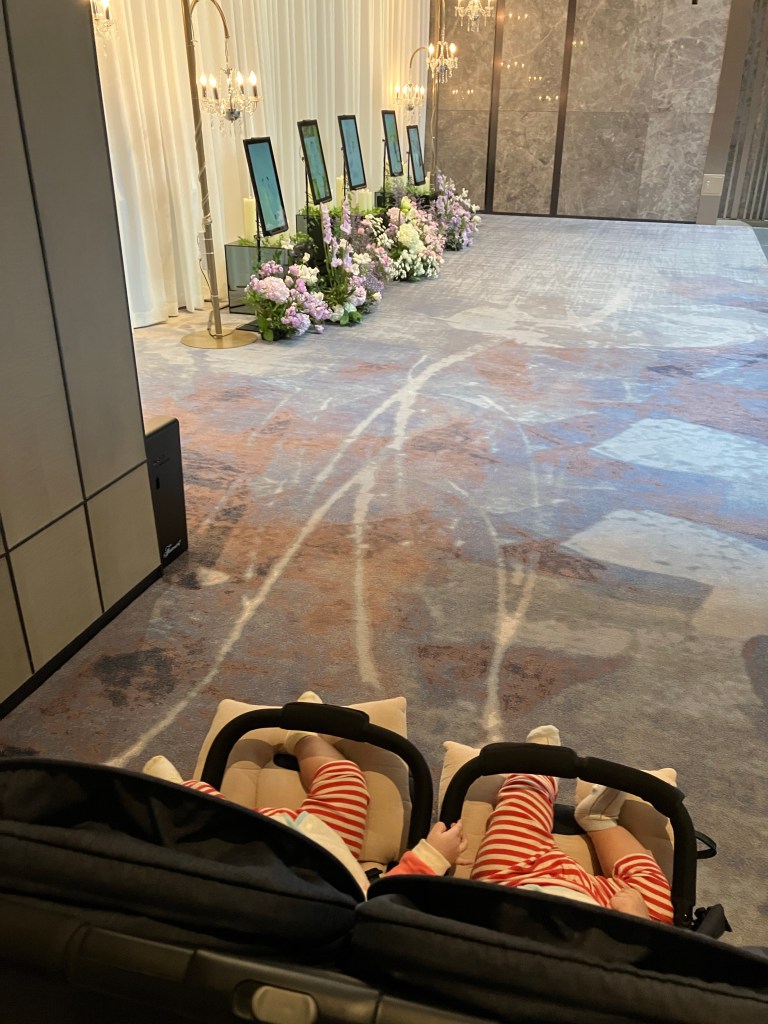
Attending a wedding is always a poignant reminder of the journey that love charts, but attending one with our 10-month-old twins in tow added layers of warmth and complexity to the celebration. The occasion was the union of dear colleague of mine, and our little family was there to witness their joyous commencement into married life.

There was a certain charm in the air that day, a blend of sophistication and heartfelt joy as we navigated the festivity with our babies. The venue, I recall, was breathtaking – dressed in elegant florals and soft, ambient lighting that seemed to promise new beginnings not just for the couple, but for all who gathered in support.

The feast laid out was nothing short of spectacular, a full-course that beckoned us to indulge in the culinary delights. However, as my wife and I alternated between caring for our little ones and trying to savor the meal, the proverbial village manifested in the kindest of ways. Our colleagues, with their intuitive gestures and nurturing spirits, took turns holding our twins, allowing us to partake in the celebration more fully. This generosity was a vivid illustration of the adage, “It takes a village to raise a child,” and never had it felt more tangible and poignant.

This simple yet profound kindness has stayed with me, compelling me to plan a token of gratitude for these colleagues, perhaps a lunch treat in the following week. It was an affirmation of the solidarity and support that can make life’s most demanding moments beautiful and memorable.

As the evening wound down, it was clear that the event was more than just a display of commitment between two individuals. It was a showcase of the collective love and support that makes such a journey possible. The sincere help from our colleagues was a gentle reminder that while love can be found in grand romantic gestures, its true essence often shines through in the quiet, selfless acts we offer each other. And as we gathered our things, our twins, now content in the arms of our extended work family, served as the perfect emblem of the day’s purest love and camaraderie.

A Night of Reflection and Understanding

Last night was one of those moments of vulnerability for our family. Both my wife and our 10-month-old twins caught a cold. Their sniffles and uneasiness disturbed the usually quiet ambiance of our home. As for me, it had been an exhausting week as I had pulled my back the previous week. The acute pain had made me almost immobile, rendering me incapable of assisting with childcare. This had left my wife singlehandedly managing both our kids and a temporarily incapacitated husband.

Amid this, there was an impending overseas business trip for me next month. It’s a privilege of my job that I can often choose when I take on assignments. However, last night, tensions rose as my wife pointed out what she perceived as my selfishness. She was overwhelmed, stressing that she doesn’t have the luxury to take time off from motherhood, no matter her health or circumstances.

Morning came, bringing with it a fresh perspective. As the sun’s rays streamed in, my wife approached with an apology. “I said too much,” she admitted. It’s not that I didn’t understand her exhaustion and frustration. I too have been trying my best, juggling between work and the responsibilities of being a new father. However, it’s an undeniable truth that the weight of childcare predominantly falls on her.

Parenthood isn’t a journey filled with only joyous moments. It is demanding, and sometimes, even overwhelming. But today, a silver lining appeared. Seeing our little ones bounce back to their cheerful selves after taking fever medicine brought immense happiness. It’s a reminder that there will always be hurdles, but together, we should tread patiently, without pushing ourselves too hard.

Life is a mix of highs and lows, and it’s essential to remember that every challenge is temporary. As we navigate the maze of parenting, it’s the little moments, like seeing our children’s recovery, that make everything worthwhile.

Raising Twins and Unexpected Setbacks: A Day in a Korean Hospital

Raising children is an adventure filled with unpredictable events, joys, and sometimes challenges. My wife and I have been blessed with twin boys, merely 10 months old. Every day with them has been special, but a recent series of unfortunate events added an unexpected twist to our journey.

It began when, quite suddenly, both my wife and I fell ill. While she was struck down with a cold, I was bedridden with severe back pain. Watching my wife muster the strength to feed our twins their weaning foods, while I could do nothing but rest, was mentally agonizing. The weight of responsibility felt even heavier, knowing it was the time for our boys to get their influenza vaccinations.

In our less than perfect state, we took the whole family to a nearby hospital in our neighborhood. The twins were set for their shots, my wife needed medication for her cold, and I was in line for some much-needed physiotherapy. The hospital was abuzz with our situation: a family of four, each requiring a different form of care.

However, amidst this chaos, the warmth and kindness we experienced were nothing short of heartwarming. Both the medical staff and fellow patients in the hospital were incredibly kind to our twin boys. It’s often said that Koreans have a soft spot for children, and on this day, we felt that sentiment in its entirety.

This challenging day turned out to be a reaffirmation of our family bonds and a testament to the supportive community around us. As we continue on our parenting adventure, we’ll cherish the kindness we received that day and the countless memories we’re building as a family.

Journey Through Time: Reflecting on Life’s Unseen Changes

As I recently stumbled upon a treasure trove of photographs from almost two decades ago, I couldn’t help but embark on a nostalgic journey through time. These photographs, frozen moments from April 2004, capture a younger version of myself, just as I was about to embark on my journey at the University of Tokyo.

Looking at these images, it’s impossible not to notice the youthful enthusiasm that radiated from not only me but also my fellow classmates. We were full of dreams, aspirations, and a sense of invincibility that only the young possess. As I perused these photographs, I was flooded with memories of late-night study sessions, shared laughter, and the thrill of new friendships being forged.

What struck me most was the realization of just how swiftly the years have passed. In the blink of an eye, two decades have gone by, each filled with its own set of trials and triumphs. Life, it seems, has a way of slipping through our fingers, often unnoticed until we take a moment to pause and reflect.

In those 20 years, not only have I grown older, but I’ve also taken on new roles and responsibilities. I’ve ventured into the realm of marriage, and now, as a parent, I find myself cherishing the same wishes for my children that I held for my classmates all those years ago – that they remain healthy, happy, and full of vitality as they navigate their unique paths through life.

As I write this, I’m reminded that life is a continuous journey of growth, change, and discovery. It’s marked by the passage of time, and it’s a journey we’re all on together, albeit at different paces and through distinct experiences. It’s a journey that has the power to surprise, to humble, and to teach us valuable lessons.

So, as I share these photographs and these reflections with you, I’m filled with a profound sense of gratitude for the journey of life – a journey that, with its twists and turns, has brought me to this moment. And as I peer into the future, I’m filled with hope and anticipation for all the adventures and changes that await, knowing that each moment is a precious snapshot in the larger tapestry of existence.