**Popular Kid Shows in Both Countries**: Introducing the twins to entertainment from both cultures.

As a Japanese living in Korea, married to a wonderful Korean woman, my life is a beautiful blend of two rich cultures. The birth of our twin babies, now 10 months old, has added even more color and joy to our lives. As they grow, we are excited to introduce them to the vibrant entertainment from both our cultures, starting with popular kid shows.

The world of children’s entertainment in Japan and Korea is as diverse as it is educational. In Japan, shows like “Anpanman” hold a special place in every child’s heart. The character, a superhero with a bread head, might sound quirky, but it’s a hit among the little ones. The show not only entertains but also imparts values like kindness and bravery.

In Korea, shows like “Pororo the Little Penguin” are immensely popular. Pororo’s adventures with friends in a snowy village are not only fun to watch but also teach valuable lessons about friendship, cooperation, and problem-solving.

As our twins start to engage more with the world around them, we find these shows to be more than just entertainment. They are windows into our respective cultures. Through “Anpanman” and “Pororo,” our babies are exposed to the language, moral lessons, and humor of Japan and Korea.

We believe that introducing our children to the richness of both cultures from an early age is essential. It’s not just about watching cartoons but about understanding and appreciating the diversity of the world they are a part of. As a multicultural family, we have the unique opportunity to blend these experiences, creating a tapestry of learning and enjoyment for our twins.

Moreover, these shows also offer us, as parents, a way to revisit our childhoods and share a piece of our past with our children. Every episode watched together is not just a moment of fun; it’s a bridge connecting generations and cultures.

In conclusion, as our twins grow, we look forward to exploring more shows from Japan and Korea. Our journey of cultural discovery through entertainment is just beginning, and we can’t wait to see where it takes our little family. We hope that by sharing our experiences, we inspire other multicultural families to embrace and celebrate their rich heritage with their children.

A Seoul Morning: Embracing the Early Winter

Living in Seoul has always been an enriching experience, and today marked my seventh year in this dynamic city. The day greeted me with a chilly reminder that winter has decided to arrive early this year, as the mercury dipped to minus three degrees Celsius.

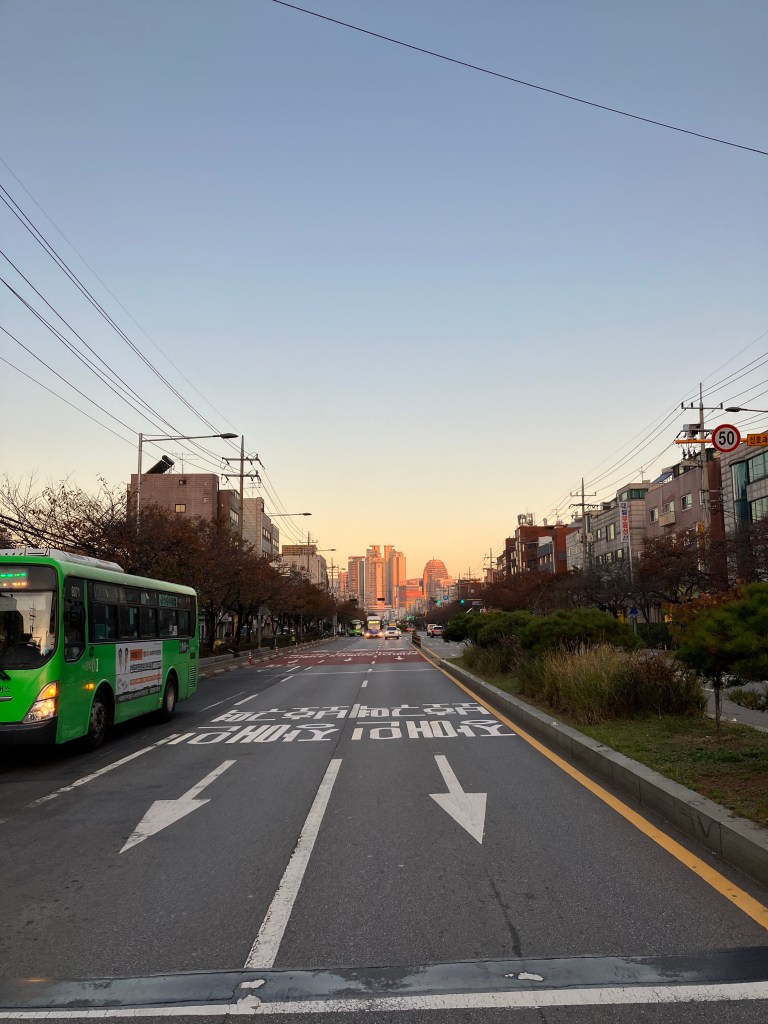
As I walked down the familiar streets this morning, the crisp air was a stark contrast to the usual mild autumns I’ve grown accustomed to. The cityscape, bathed in the soft light of dawn, seemed to brace itself for the season ahead. I captured a moment of this morning’s ambience, the roads less traveled by vehicles and more by the golden hues of the rising sun, painting a serene picture of Seoul waking up.

The photograph from this morning is more than just a snapshot of a day; it’s a reflection of life here. The bus, green and vibrant, moves along the road, a symbol of the city’s unceasing energy. The streets, marked with arrows pointing forward, remind me of the direction my life has taken since moving here.

Seoul, a city that harmoniously blends the rapid pace of modern life with the stillness of nature, has been my home for quite some time now. And as the seasons change, I find myself changing with them, growing and learning more from this place I’ve come to love. This unexpected onset of winter is yet another chapter in my journey here, a reminder of the transient beauty of life in Korea.

Unraveling the Linguistic Ties: Exploring Korean, Japanese, and Chinese Through Shared Characters

The Fascinating World of East Asian Languages

Language enthusiasts often find themselves drawn to the intricate and interwoven tapestry of East Asian languages – Korean, Japanese, and Chinese. What makes these languages particularly fascinating is their shared use of Chinese characters, albeit with unique adaptations and pronunciations. This linguistic journey reveals not just words and grammar, but a deep cultural and historical connection among these nations.

A Tale of Shared Characters

Korean and Chinese: A Phonetic Resemblance

Korean and Chinese share a remarkable similarity in the pronunciation of many Chinese characters (known as Hanja in Korean and Hanzi in Chinese). A notable feature is the way certain syllables, especially those ending in “n” and “ng”, correspond closely between the two languages. For instance, the character “本”, pronounced as “ben” in Chinese, bears a close resemblance to its Korean counterpart “bon”. Similarly, “能” is “neng” in Chinese and “neung” in Korean. These phonetic parallels are not mere coincidences but reflect a deep historical connection, tracing back to when these languages borrowed and adapted Chinese script to their linguistic systems.

Japanese: An Intriguing Divergence

The Japanese language, while also heavily influenced by Chinese characters (Kanji), presents an intriguing divergence. The adaptation of Chinese characters into Japanese involved significant modifications. One striking aspect is the alteration of the syllable structure, as seen in the character “能”, which is pronounced as “noh” in Japanese, contrasting with the “ng” ending in Chinese and Korean. Additionally, Japanese incorporates two readings for Kanji: the On’yomi (based on the original Chinese pronunciation) and the Kun’yomi (a native Japanese reading). This dual reading system adds a layer of complexity and richness to the language.

Comparative Learning: A Gateway to Deeper Understanding

For language learners, exploring these three languages simultaneously opens up a fascinating world of comparative linguistics. It offers a unique opportunity to understand how languages evolve and influence each other. While it poses certain challenges, like keeping track of the differences in pronunciation and meaning, the benefits are manifold. It provides a more comprehensive understanding of East Asian culture and history, as language is a gateway to the soul of a culture.

Cultural and Linguistic Interplay

The linguistic interplay among Korean, Japanese, and Chinese is not just a matter of phonetics; it’s deeply rooted in the historical and cultural exchanges that have shaped East Asia. Understanding this context enriches the learning experience, as it goes beyond mere language acquisition to embrace a broader cultural understanding.

Concluding Thoughts

The study of Korean, Japanese, and Chinese through their shared use of Chinese characters is more than a linguistic endeavor; it’s a journey through history and culture. It highlights the interconnectedness of these languages and, by extension, the countries themselves. For learners and enthusiasts, this exploration is not just about mastering languages, but also about gaining insights into the rich tapestry of East Asian heritage. So, dive in and discover the intriguing linguistic ties that bind Korean, Japanese, and Chinese, and let them guide you through the fascinating corridors of history and culture.

Harnessing the Power of AI: A Personal Journey with ChatGPT

As a newcomer to the world of ChatGPT, my initial interactions were akin to using it as a replacement for Google searches. I peppered it with various questions, trying to understand its capabilities. However, the true prowess of ChatGPT emerged when I shifted from asking “What is this?” to giving more directive instructions like, “Write this, under these specific conditions.” This transition felt like discovering an exceptionally intelligent secretary, a being not just of vast knowledge, but of profound intellect.

In Japan, there’s a common narrative about graduates from the University of Tokyo (Todai). As these bright young minds join companies, they often encounter senior colleagues who challenge them with questions like, “Do you know this? Or that?”—a subtle way of testing and, at times, undermining their intelligence. But these Todai graduates are not just repositories of information; their true essence lies in their intellect.

Just as these company veterans eventually learn to appreciate and effectively utilize the talents of their Todai juniors, transforming into supportive colleagues, I too have begun to harness the full potential of ChatGPT. It’s not just about the information it provides, but how it processes and presents that information.

While it’s too early to say whether ChatGPT is a greater invention than the internet itself, personally, I feel it may prove to be more beneficial for me than social media ever was. ChatGPT, in my experience, is more than a tool; it’s an intellectual companion, one that complements and enhances my own thinking process. This journey has not only been about discovering what ChatGPT can do but also about understanding how best to utilize this remarkable technology.

**Exploring Korea Through Japanese Eyes**: Highlighting interesting places, eateries, and cultural spots.

Life as a Japanese expatriate in Korea has been a journey filled with fascinating discoveries and cultural exchanges. Now, with my Korean wife and our adorable 10-month-old twins, our adventures have taken a new turn, blending family life with the exploration of this vibrant country.

In the past, living in Incheon offered us the privilege of exploring nearby islands like 강화도 (Ganghwa-do) and 영종도 (Yeongjong-do). Each visit was a delightful escape, revealing serene landscapes and a tapestry of cultural richness that is uniquely Korean. The charm of these islands lies not only in their natural beauty but also in their ability to encapsulate Korea’s history and modernity in one frame.

Ganghwa-do, an island etched with history, was more than just a travel destination for us; it was a living museum. Strolling through the historic sites, we felt the echoes of the past, from ancient dolmens to fortresses that stood testament to Korea’s resilience. The island’s tranquility, contrasted with these historical landmarks, created a surreal experience, akin to walking through time.

Yeongjong-do presented a different allure. Known for housing Incheon International Airport, this island was a gateway to the world and a symbol of Korea’s global connectivity. Beyond its role as a transport hub, Yeongjong-do was a treasure trove of local experiences. Its beaches, offering a panoramic view of the Yellow Sea, were a serene retreat from the bustle of city life.

One of the most memorable aspects of our island visits was exploring the local markets. These markets were not just centers for commerce; they were vibrant hubs of culture and community life. Each visit was an opportunity to engage with local vendors, discover traditional Korean crafts, and indulge in an array of street foods that tantalized our taste buds. From savoring freshly made tteokbokki to exploring stalls brimming with handmade goods, these markets were a microcosm of Korea’s rich cultural tapestry.

Now, with the twins, our travels have become less frequent, but the memories of these places remain vivid. We look forward to introducing our children to these cultural gems, sharing stories of our adventures, and creating new ones as a family. Korea, through our Japanese eyes, has been a blend of discovery, learning, and admiration. It’s a country where tradition and modernity coexist harmoniously, offering endless opportunities for exploration and growth.

As our twins grow, we eagerly anticipate the day when we can once again roam the islands, wander through local markets, and immerse ourselves in the cultural richness of Korea. Until then, we cherish the memories and plan for future adventures, knowing that each experience will be an invaluable part of our family’s story.

The Addictive Nature of Sales: A Path to Entrepreneurial Thinking

The role of a salesperson, often perceived as laden with stress, holds a paradoxically addictive charm due to the immense sense of achievement felt upon reaping rewards. This profession, unlike many others, uniquely positions individuals closer to an entrepreneurial mindset. Just as entrepreneurs experience significant stress, they too find themselves addicted to the satisfaction derived from their accomplishments.

Being a salesperson is not merely about pushing products or services; it’s a journey of resilience and strategic thinking. The constant pressure to meet targets and the unpredictability of customer responses can be overwhelming. However, it’s precisely these challenges that forge a mindset akin to that of an entrepreneur. Sales professionals learn to navigate uncertainties, adapt to varying market conditions, and understand the intricate balance between risk and reward – skills that are quintessential to successful entrepreneurship.

Moreover, the satisfaction a salesperson feels upon closing a deal or surpassing a sales target is comparable to an entrepreneur’s joy in witnessing their business thrive. This sense of fulfillment is not just about the financial gain; it’s about seeing the tangible results of one’s efforts and strategy. It’s a validation of their ability to influence, persuade, and succeed – a thrill that becomes addictive.

Yet, this addiction is not necessarily detrimental. It propels sales professionals to strive for continuous improvement and innovation, much like entrepreneurs who continually seek growth and development for their businesses. This shared trait indicates a deeper connection between the worlds of sales and entrepreneurship.

In essence, the life of a salesperson is more than a career choice; it’s a journey towards an entrepreneurial mindset. The stress and challenges encountered are not just hurdles but stepping stones to mastering the art of business. For those in sales, the journey is tough, but the addictive satisfaction of success makes every challenge worth conquering.

The Primacy of Music in Human Memory and Communication

I’ve always been captivated by the idea that even when humans succumb to dementia and lose their grasp on language, they can still recall the music they listened to in their youth until their final moments. This notion resonates deeply with me, especially now as a new parent.

Recently, I experienced the joy of welcoming a child into the world. Although my baby is yet to speak, there’s a clear delight that sparkles in those tiny eyes whenever I sing a song. This interaction has led me to a profound realization: perhaps, for us humans, music precedes language.

Isn’t it fascinating to consider that before we even begin to weave words into sentences, we are attuned to the rhythms and melodies of music? It’s as if our earliest form of communication isn’t spoken but sung, embedded in the lullabies that soothe us and the melodies that move us.

Moreover, this experience has made me ponder the essence of language itself. Could it be that language is, in its most fundamental form, a type of music? The rise and fall of intonation, the rhythm in our cadences, the melody that we unconsciously infuse into our spoken words – all these elements seem to echo the fundamental nature of music.

Therefore, as my child grows, I find myself more attuned to the musicality inherent in our everyday interactions. Whether it’s the soothing tune of a lullaby or the joyful expression in a simple nursery rhyme, the power of music in shaping our earliest memories and forming our initial understanding of the world is undeniable.

As I continue this journey of parenthood, I am reminded of the timeless bond between music and human memory, communication, and emotion. In many ways, music is our first language, a universal medium that transcends words yet speaks volumes about our shared human experience.

Embracing the Present: A Journey from Japan to Korea

Recently, I reconnected with an old friend who shared something with me that both surprised and delighted me. They pointed out that one of my greatest strengths, and something they admired, was my ability to focus on the present. This observation resonated deeply with me, especially considering the path I’ve taken in my life.

A few years ago, I made a significant decision to leave a major corporation in Japan. It was a comfortable, stable environment, but I felt a strong urge for change. This led me to South Korea, where I embarked on a new career as a salesperson. The transition was not without its challenges. There were moments filled with doubt and anxiety, times when I questioned my decision and my capabilities.

However, my friend’s words have given me a new perspective. They made me realize that my ability to concentrate on the present has been a key factor in navigating this journey successfully. In the midst of uncertainty and change, focusing on the present has allowed me to adapt, learn, and grow in ways I never thought possible.

My experience so far in Korea has been rewarding. I’ve found success in my role, and each day brings new opportunities to learn and to connect with people from diverse backgrounds. This journey has taught me the importance of embracing the present, no matter how uncertain or challenging it may seem.

Reflecting on my friend’s words, I feel a renewed sense of confidence. They reminded me that sometimes, the very traits we overlook in ourselves are the ones that carry us through life’s most transformative phases. As I continue my journey here in Korea, I am grateful for these moments of realization and the friends who help light the way.

**Dual Citizenship for Kids**: The pros, cons, and personal experiences.

When my wife and I welcomed our twin babies into the world ten months ago, we were not just bringing new life into our family; we were merging two cultures, two histories, and potentially, two nationalities. As a Japanese man living in Korea, married to a Korean woman, the question of our children’s citizenship was not just a formality but a doorway to a world of possibilities and challenges.

The benefits of dual citizenship for our babies are multifaceted. It’s a bridge that connects them to their rich heritage on both sides of the East Sea. They will have the chance to learn and fluently speak two languages, Japanese and Korean, which will open many doors in the future in terms of education and career opportunities. Moreover, they will have access to the social services and educational systems of both countries, experiencing the best of both worlds.

However, dual citizenship also comes with its complications. Each country has its own set of laws and regulations regarding citizenship, and navigating these can be a bureaucratic challenge. There is also the issue of national service requirements, as in Korea, which could impact our sons in the future. Moreover, having a dual identity might sometimes pose a question of loyalty or belonging for our children, especially in times of political tensions between the two nations.

Our personal experience has been a journey of learning and adaptation. We’ve grappled with paperwork, experienced the confusion of differing legal systems, and faced the curious stares and questions from those surprised by the twins’ mixed heritage. Yet, seeing them babble to each other in a mix of Korean and Japanese sounds is a reminder of the unique world they will grow up in—a world where they can proudly claim, “I am both.”

In conclusion, dual citizenship for our babies is a gift of double the identity, culture, and opportunities. As parents, our role is to guide them through the complexities and celebrate the union of our two worlds in the small miracles that are our children.

**Navigating Friendships for Bicultural Kids**: How the twins form connections with peers from diverse backgrounds.

In the heart of Seoul, nestled between the modern skyscrapers and traditional hanoks, my wife and I are raising our 10-month-old twins. As a Japanese father and Korean mother, we are acutely aware of the rich cultural tapestry that forms the backdrop of our children’s lives. Our little ones are growing up in a household where two languages babble over each other like a brook over pebbles, and where holidays and traditions merge to form a delightful blend of Korean and Japanese customs.

At just 10 months old, our twins are already showing signs of their burgeoning identities, reaching out with tiny hands to a world much larger than themselves. They are the embodiment of a bridge between cultures, with their dual heritage laying the groundwork for a lifetime of friendships across various backgrounds. As they giggle and play with Korean and expatriate children alike in our local park, I can’t help but marvel at the ease with which they form connections.

The essence of friendship at this tender age is simplicity itself – a shared toy, a simultaneous laugh, a mutual curiosity for the colorful world around them. These initial interactions, though seemingly trivial, are the building blocks of their social development and a testament to the universal language of play.

However, as they grow, we anticipate the complexities that may arise from their bicultural roots. Will they struggle to fully integrate into either of their native cultures? Or will they navigate their dual identities with the dexterity of a weaver combining threads to create a beautiful tapestry? Only time will tell.

Our role as parents is to guide them through these cultural currents, ensuring they feel grounded and confident in their heritage. We are determined to arm them with the understanding and empathy needed to bridge cultural divides, hoping to foster in them a natural ability to connect with peers from all walks of life.

As we watch our twins lay the foundation of their social network, we are reminded that the beauty of our interconnected world lies in its diversity. We look forward to seeing how our little ambassadors of culture will contribute to the tapestry of their generation, making friends from diverse backgrounds and, in the process, weaving their own unique identities.

In this journey, we are not just raising children; we are nurturing future citizens of the world. And perhaps, through their innocent interactions, our twins will teach us a thing or two about forging connections in a multicultural world.

**Raising Kids in Korea: A Japanese Perspective**: Unique experiences and insights from living in Korea.

As a Japanese individual living in Korea, I’ve had the unique privilege of experiencing life from two rich and distinct cultural perspectives. This experience has been further enriched by the joy of raising twin babies, who are now 10 months old, in this vibrant country.

Raising children in a country different from your own offers an array of challenges and opportunities. For my wife, who is Korean, and me, it’s a daily journey of blending our cultures and traditions to create a nurturing environment for our twins. We’re keen on instilling in them a sense of respect and appreciation for both Japanese and Korean cultures.

Korea, with its deep-rooted traditions and rapidly evolving society, presents a fascinating backdrop for child-rearing. The emphasis on education, respect for elders, and the importance of community are values that resonate deeply with my Japanese upbringing. However, Korea’s unique approach to these values brings a new perspective and understanding.

One of the most striking aspects of raising kids here is the communal approach to parenting. Neighbors and friends often play a significant role in a child’s life, embodying the proverb “It takes a village to raise a child.” This sense of community is something that I greatly admire and somewhat contrasts with the more individualistic approach I observed back in Japan.

The local cuisine is another area where our children are getting the best of both worlds. Korean food, known for its bold flavors and nutritious ingredients, is a daily part of our diet. We also make sure to introduce them to Japanese dishes, thereby cultivating their taste for diverse flavors from an early age.

Language development is an interesting aspect for our twins. They’re being raised in a bilingual environment, absorbing both Korean and Japanese. This exposure will not only enhance their cognitive abilities but also deepen their connection to both cultures.

The challenges, however, are also part of this journey. Navigating the healthcare system, understanding parenting norms, and even simple tasks like finding the right products for our babies can be daunting at times. But these challenges are dwarfed by the joy of seeing our children grow up in a rich, culturally diverse environment.

In conclusion, raising kids in Korea as a Japanese parent has been an enlightening and rewarding experience. It’s a journey filled with learning, love, and a blend of cultures that enriches our family’s life in unimaginable ways. Our hope is that our twins grow up with a broad perspective, understanding, and appreciation for both their heritages, becoming true citizens of the world.

Navigating the Complexity of Names in a Multilingual Context

Names are inherently complex, embodying cultural, historical, and personal significance. This complexity is magnified when one steps into the realm of foreign languages. As a Japanese individual working in South Korea, I have firsthand experience grappling with the intricacies of Korean names—a challenge distinct from the familiarity of Japanese names.

Unlike in Japan, where names often clearly indicate gender, Korean names do not always offer this distinction at first glance. This ambiguity is not just a hurdle for foreigners like myself but also occasionally confounds Koreans. The subtleties in Korean names, deeply rooted in their culture, often escape the untrained ear.

Further complexity arises from the Korean language’s pronunciation nuances. For instance, consider the name 박민지. The pronunciation of Korean consonants can vary, making it difficult to discern whether the surname is 박 (Park) or 방 (Bang) based solely on pronunciation. Such linguistic characteristics add layers of complexity, making the understanding and usage of Korean names a challenging yet fascinating aspect of cross-cultural communication.

In this globalized era, where multicultural interactions are commonplace, understanding the nuances of names across different cultures is not just a linguistic exercise but a step towards deeper cultural appreciation and sensitivity. It’s a journey that requires patience, openness, and a willingness to learn, as names are more than mere identifiers; they are gateways to understanding the rich tapestry of human diversity.