Welcome to an in-depth exploration of recent market trends, with a focus on the pivotal role NVIDIA is playing in shaping short-term market trajectories. As we delve into this analysis, let’s engage in some meta-cognition, reflecting on our understanding and thought processes regarding these market phenomena.
A Look Back: Market Rebound and Historical Context
On August 6, 2024, Asian stock markets, including South Korea, rebounded after three days of declines. This rebound momentarily calmed the nerves of investors who couldn’t help but recall the dramatic crashes of the dot-com bubble in 2000 and the global financial crisis in 2008. Despite this temporary relief, there’s a prevailing sentiment among market experts that the chances of a sustained rebound are slim. The market remains shrouded in uncertainty due to looming concerns about the US economic slowdown, the unwinding of yen carry trades, and the unpredictable performance of AI-related stocks.
Here, we pause to consider how our past experiences and knowledge of historical market crashes influence our current perceptions and decisions. This meta-cognitive reflection helps us understand why investors might be wary despite positive short-term movements.
NVIDIA: The Catalyst in Focus
NVIDIA’s upcoming Q2 earnings report, scheduled for August 28, is a key event that could determine the market’s direction in the near term. NVIDIA’s latest AI chip, “Blackwell,” has been a game-changer, propelling the stock prices of AI-related companies worldwide. The recent synchronization of stock prices between NVIDIA and major Korean tech giants like Samsung and SK Hynix underscores NVIDIA’s significant influence. Investors are keenly aware that NVIDIA’s performance could set the tone for the broader market.
By reflecting on the potential impact of NVIDIA’s earnings, we can better appreciate the interconnectedness of global markets and the ripple effects a single company’s performance can have. This meta-cognitive insight highlights the importance of staying informed about key players in the market.
Upcoming U.S. Economic Indicators
Next week, two critical U.S. economic indicators will be released: July retail sales (August 14) and weekly initial jobless claims (August 15). Positive results could alleviate some fears of a recession, providing a much-needed boost to market confidence. Additionally, the Jackson Hole Economic Symposium starting on August 22 is expected to shed light on the Federal Reserve’s monetary policy stance.
Reflecting on these indicators, we recognize the importance of economic data in shaping market sentiment. Our understanding of how macroeconomic factors influence investor behavior can guide us in making more informed decisions.
The Yen’s Volatility
The recent volatility in the yen-dollar exchange rate is another variable attracting significant attention. After peaking at 160 yen per dollar in June, the rate plummeted to 141 yen, sparking concerns about the unwinding of yen carry trades. The Wall Street Journal estimates the scale of these trades at around $20 trillion. Monitoring the Japanese authorities’ policy responses will be crucial in assessing whether the yen’s sharp decline will stabilize.
By contemplating the yen’s impact, we gain a deeper understanding of how currency fluctuations can affect global markets. This reflection enhances our ability to anticipate market movements based on forex trends.
Conclusion: Navigating Uncertainty with Meta-Cognitive Awareness
In conclusion, the market remains in a state of flux, influenced by a web of interconnected factors. NVIDIA’s earnings, U.S. economic indicators, and yen volatility are all critical elements that will shape short-term market dynamics. By engaging in meta-cognitive reflection, we can better understand the complexities of the market and the interplay between various forces.
As we navigate these uncertain waters, it’s essential to remain vigilant, stay informed, and continuously reflect on how our perceptions and knowledge shape our investment decisions. This meta-cognitive approach not only enriches our understanding but also equips us with the tools to respond more effectively to market changes.
Stay tuned for more insights as we continue to explore the ever-evolving landscape of global markets.
Hello everyone! Today, let’s delve into the significant market surge that occurred on August 6, 2024, in the South Korean and Japanese stock markets. This topic isn’t just fascinating for investors but also for anyone interested in economic trends.
Background of the Surge
First, let’s briefly outline the background of this surge. South Korea’s KOSPI and KOSDAQ indices rebounded sharply in a single day after overcoming fears of an impending recession. This extraordinary event was marked by the simultaneous activation of the “buy-sidecar” mechanism in both the KOSPI and KOSDAQ markets for the first time in four years and two months.
Similarly, the Japanese stock market saw a significant rebound. The Nikkei 225 index surged by 10.2% from the previous day, recording its largest one-day gain since 1990. Taiwan’s Taiex index also rose by 3.3%.
Investor Activity
Behind this surge was the aggressive buying activity of individual investors. For instance, in South Korea’s securities market, individual investors net bought 455.5 billion won. In contrast, foreign and institutional investors continued to sell.
Market Reactions and Future Outlook
Major stocks in South Korea’s KOSPI index also saw notable gains. Samsung Electronics, SK Hynix, and LG Energy Solution each rose by 4-6%. Additionally, shipbuilding stocks, which had plummeted the previous day, rebounded sharply.
On the currency front, the won-dollar exchange rate edged up slightly to 1,375.6 won.
Metacognitive Insights
Now, let’s take a metacognitive approach to this situation. This surge exemplifies how investor psychology can significantly impact the market. ‘Fear’ can trigger massive sell-offs, and when it becomes excessive, it can lead to a wave of buying, causing the market to rebound sharply. This dynamic showcases the profound influence of investor sentiment on market movements.
The contrasting behavior of individual and institutional investors is also noteworthy. Individual investors tend to act more aggressively for short-term gains, whereas institutional investors focus more on risk management. This divergence contributes to market volatility.
Conclusion
The recent surge underscores the intricate relationship between investor psychology and market dynamics. Understanding market trends requires not only looking at economic indicators and corporate performance but also considering the psychological state of investors. As we move forward, keeping an eye on these factors will be crucial for making informed investment decisions.
Thank you for reading until the end. I hope this article helps you better understand the market and economic trends. See you next time!
1. The Current State and Challenges of AI-Related Stocks
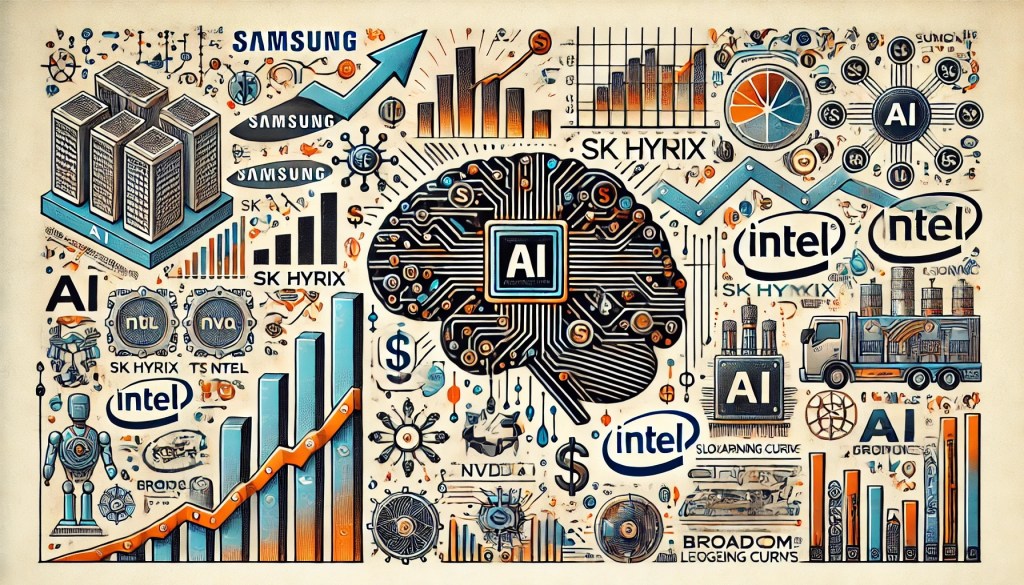
Recently, AI (artificial intelligence) related stocks have been a significant topic of interest, with various concerns and challenges surfacing. Over the past 2-3 years, the AI industry has experienced rapid growth, with many companies actively investing in AI technology. However, recently, questions have been raised about the profitability of these investments, leading to a decline in AI, semiconductor, and power-related stocks both domestically and internationally.
Samsung Electronics’ stock price fell by 10.30%, and SK Hynix dropped by 9.87%. Additionally, companies related to AI power supply, such as content and cable companies, have also recorded significant declines. In the US market, major AI-related companies like NVIDIA, Amazon, and Microsoft have seen their stock prices fall as well.
2. Intel’s Performance and the Profitability Issue in the AI Industry
Intel’s stock price dropped by 26.06%, which also caught attention. Intel CEO Pat Gelsinger stated during their performance announcement that they have not yet achieved complete profitability regarding major AI trends, highlighting the high costs and low profit margins as significant issues.
Moreover, the annual salary for an OpenAI engineer is about 2 billion won, which adds to the concern. With the depletion of significant learning data and the difficulties in achieving future profitability, the challenges continue to mount.
3. Stagnant AI Demand and Delayed Digital Transformation (DX)
The digital transformation (DX), which is crucial for AI adoption, is still ongoing, with many companies working towards it. However, due to economic downturn concerns, it is challenging to make quick decisions on large-scale AI transitions.
On the other hand, the rapid emergence of innovative AI services and the depletion of data necessary for AI learning are also concerning. This depletion could slow down AI learning speeds, potentially hindering technological advancements.
4. Investment Strategies and Future Outlook
Experts emphasize the need to discern between valuable and less valuable AI-related stocks carefully. They suggest avoiding stocks that have risen sharply due to high expectations and focusing on core companies instead. Companies at the center of AI hardware and semiconductor fields, such as NVIDIA, TSMC, and Broadcom, are considered valuable for a strategic approach involving purchasing during price corrections.
There is also growth potential for domestic AI-related equipment and infrastructure companies. Major high-tech companies continue to expand their AI equipment investments, and high-bandwidth memory (HBM) related stocks may see some rebound. AI software companies that pursue a ‘focused strategy’ could maintain growth by providing services to security-conscious government and public institutions and by targeting emerging markets in Southeast Asia.
5. Conclusion
The AI industry faces numerous challenges and growth opportunities. It is essential to monitor technological advancements and market trends carefully while establishing a sound investment strategy. Prioritizing investments in core companies and aiming for efficient growth are crucial. Keeping a close eye on the AI industry’s developments and making informed decisions will be key moving forward.
最近、英語の勉強中に特に印象に残った二つの表現があります。それは「No day is ever typical」と「Goes a long way」です。これらの表現は一見すると簡単に思えるかもしれませんが、その中には日々の生活や仕事の取り組み方に深い洞察を与えてくれる力が秘められています。今回は、この二つの表現について詳しく紹介し、その意義を探ってみましょう。
記事の中で「No day is ever typical」という表現は、社員たちが毎日異なる課題や機会に直面している様子を説明するために使われていました。例えば、ある日は新しい製品の開発に取り組み、翌日には投資家にプレゼンテーションを行うといった具合です。この表現は、職場のダイナミックで刺激的な雰囲気を強調していました。
意味と解説
「No day is ever typical」は、「どの日も決して典型的な日ではない」という意味で、日々の予測不可能性や変化に富んだ生活を示しています。この表現は、特に仕事や生活が単調ではなく、常に新しい挑戦や機会がある状況を表現する際に使われます。
例文や会話例
例文
In the emergency room, no day is ever typical; every shift brings new challenges.
緊急治療室では、どの日も決して典型的な日ではありません。毎シフトが新しい挑戦をもたらします。
As a journalist, no day is ever typical because you never know what story you’ll be covering next.
B: It’s really unpredictable. No day is ever typical. One moment I’m treating a patient with a minor injury, and the next I’m dealing with a critical emergency.
B: It’s exciting because no day is ever typical. One day I might be covering a local event, and the next day I’m reporting on a major breaking news story.
「No day is ever typical」と「Goes a long way」という二つの表現は、日常生活や仕事の取り組み方に新たな視点を与えてくれます。毎日が異なる挑戦と機会に満ちていることを楽しみながら、小さな行動が長期的に大きな効果を生むことを理解することで、より充実した人生を送ることができるでしょう。これらの表現を日々の生活に取り入れて、変化を受け入れ、積極的な姿勢で取り組んでみてください。
In the course of my professional journey, I have encountered myriad situations that illuminate the intricate dynamics of workplace relationships. Recently, a particular incident has prompted me to reflect deeply on the balance between professional conduct and personal well-being.
Our office recently convened for a social gathering, an event intended to foster camaraderie among colleagues. I attended the initial phase of the gathering, after which I returned home. The revelry, however, continued well into the night, culminating in a third round of festivities. During this extended gathering, a video was taken of my colleagues joyfully engaging in karaoke. This video was subsequently shared on our internal company chat.
The following day, a senior colleague instructed me to disseminate this video on another company communication channel. Dutifully, I complied with this request. Shortly thereafter, I was confronted with an impassioned message from a young lady featured in the video, demanding its immediate removal. Respecting her wishes, I promptly deleted the video.
This young lady, a compatriot and considerably my junior, has exhibited a pattern of contentious interactions with other male colleagues. Her proclivity for seizing upon minute verbal inflections to provoke disputes had not gone unnoticed. This recent incident served to crystallize my understanding of her behavior. It became evident that her fervent, almost naive, aggressiveness was a significant factor in her frequent workplace altercations.
Her position as the only Japanese woman in our office, amidst predominantly Korean colleagues, undoubtedly contributes to her stress. While she maintains outwardly cordial relationships with her peers, the underlying strain of navigating a foreign cultural landscape is palpable.
This essay is an attempt to document my realizations and concerns. I am firmly convinced that her departure from our workplace would ultimately serve her best interests. The discomfort I experienced today is a manifestation of deeper, long-standing sentiments that are unlikely to abate.
Her resignation, I believe, would be the most prudent course of action for her. As a colleague and fellow countryman, I empathize profoundly with the pressures she endures. However, the misdirection of this stress towards her colleagues is a matter of grave concern. Out of a sincere desire for her well-being, I earnestly hope she will consider leaving her position at the earliest opportunity.
In our conversations, she has confided in me her anxieties as a woman navigating the precarious terrain of commission-based sales. Her concerns are entirely understandable. Notably, she mentioned that resigning around the time of childbirth would represent a harmonious conclusion to her tenure. It is a poignant reminder that life encompasses much more than one’s professional identity. I wholeheartedly support her in this prospective new chapter and wish her the utmost happiness and fulfillment.
In conclusion, this reflection underscores the delicate balance between professional obligations and personal well-being. It is a reminder that our workplaces are microcosms of larger societal dynamics, where individual actions can significantly impact collective harmony. It is incumbent upon us to navigate these spaces with empathy, understanding, and a steadfast commitment to the well-being of our colleagues.
In the labyrinthine world of human interactions, one can assert with some confidence that nothing is inherently given or absolute. This notion, complex as it is, extends to the realms of benevolence and goodwill, which are, more often than not, conditional rather than unconditional. These intricate dynamics became palpably clear to me during a recent ordeal at my workplace.
As a seasoned salesperson in a competitive, commission-based industry, I recently faced the distressing experience of a Predictive Index (PI) test administered by my employer. Despite being the most senior salesperson and having earned the distinguished title of the top salesperson in Asia the previous year, I found myself overshadowed by a younger colleague whose test performance was nothing short of exemplary.
This situation is emblematic of a broader issue prevalent in many modern workplaces: the reliance on evaluative measures that may not fully encapsulate an individual’s capabilities or contributions. Such tests, while perhaps intended to identify strengths and areas for development, can inadvertently undermine the morale and self-esteem of seasoned professionals who may not perform well under such specific conditions.
The experience evoked poignant reflections on my youth, spent under the rigorous and often merciless scrutiny of preparatory schools akin to Japan’s renowned Fourtsu Yotsuya Otsuka. These memories, steeped in the relentless pressure of academic performance, served as a stark reminder that the echoes of past experiences often reverberate into our present, influencing our perceptions and reactions in profound ways.
My visceral response to these evaluative measures was one of disdain for the company and its leadership, articulated with a fervor that remains raw. Such feelings, however, also presented an opportunity for introspection and growth.
To navigate these turbulent waters, I found it crucial to reaffirm my past achievements and current capabilities. Recognition of my historical successes, such as the notable accolade of being the top salesperson in a vast and competitive market like Asia, served as a potent reminder of my inherent worth and competence.
Seeking constructive feedback on the test results to identify specific areas for improvement proved to be another valuable strategy. This pragmatic approach not only facilitated personal development but also demonstrated a commitment to continual growth, a quality highly regarded in any professional context.
Stress management became a vital aspect of coping with these pressures. Engaging in activities that promote mental and physical well-being—whether it be exercise, meditation, or a cherished hobby—provided much-needed respite and clarity.
Engaging in a candid dialogue with superiors about the evaluative process also proved beneficial. Constructive conversations led to a better understanding of the intent behind such measures and potentially paved the way for more holistic and fair evaluation practices in the future.
Lastly, seeking professional counseling or coaching offered valuable support. These resources assisted me in processing my emotions, managing stress, and developing strategies to navigate complex professional landscapes effectively.
In conclusion, while the pressures of modern evaluative measures can indeed be daunting, they also offer a unique opportunity for reflection and growth. By reaffirming one’s achievements, seeking constructive feedback, managing stress, engaging in open dialogue, and utilizing professional support, individuals can navigate these challenges with grace and resilience. Ultimately, it is through such trials that we often discover our true strengths and capacities, emerging stronger and more self-assured in our professional and personal lives. This personal journey has reinforced my belief in the importance of resilience and the continual pursuit of self-improvement, no matter the challenges we face.
The Cold War era, a period marked by geopolitical tension between the Soviet Union and the United States, profoundly influenced various aspects of global economics and culture. Three notable examples of entities that thrived during this unique period—only to face significant decline post-Cold War—are Anchorage, Japanese electronics, and Hong Kong cinema. Each of these serves as a testament to the transient nature of prosperity tied to specific historical contexts.
Anchorage: A Strategic Hub Turned Logistic Center
During the Cold War, Anchorage, Alaska, stood as a crucial strategic military and civilian aviation hub. Its geographical location made it indispensable for both military operations and commercial air routes connecting the Far East with Western Europe. Due to the limited range of aircraft at the time and the inability to traverse Soviet airspace, Anchorage became a vital refueling and logistics point.
However, with the end of the Cold War and advancements in aviation technology allowing for longer non-stop flights, Anchorage’s strategic importance waned. Today, while it remains a significant cargo and logistical hub, its military relevance has diminished. The shift highlights how technological progress and geopolitical changes can render once-critical locations less pivotal in global strategies.
Japanese Electronics: From Dominance to Decline
Japanese electronics experienced a meteoric rise during the Cold War, driven largely by American economic support aimed at strengthening Japan as a bulwark against communism. The post-World War II economic boom saw companies like Sony and Panasonic becoming household names globally, thanks to their innovative and high-quality products.
This golden age, however, began to fade following the 1985 Plaza Accord, which resulted in a strong yen and made Japanese products more expensive internationally. Concurrently, South Korean and later Chinese manufacturers entered the market with competitive pricing and improving quality, eroding Japan’s dominance. The inability to maintain price competitiveness and a failure to innovate as rapidly as new players led to a significant decline in the global market share of Japanese electronics. This transition underscores the fragile nature of industrial supremacy in the face of shifting economic policies and global competition.
Hong Kong Cinema: Cultural Beacon to Regional Player
In the realm of cinema, Hong Kong emerged as a cultural powerhouse during the Cold War. Its unique position as a bridge between East and West fostered a vibrant film industry that peaked in the 1980s. Directors like John Woo and actors such as Bruce Lee and Jackie Chan brought international acclaim to Hong Kong cinema, which was renowned for its distinctive style and high-energy action sequences.
The tide turned with China’s economic reforms and the subsequent reintegration of Hong Kong in 1997. The burgeoning Chinese film industry, supported by substantial domestic investment, began to overshadow Hong Kong’s. Additionally, the global dominance of Hollywood posed further challenges. While the 2002 film “Infernal Affairs” achieved international success, it was one of the last Hong Kong films to do so on such a scale. The decline in global influence of Hong Kong cinema mirrors broader shifts in economic power and cultural production from regional to global contexts.
Conclusion
The stories of Anchorage, Japanese electronics, and Hong Kong cinema illustrate how the Cold War’s unique geopolitical and economic landscapes fostered temporary periods of exceptional growth and influence. However, these same factors also contributed to their subsequent declines as the world evolved post-Cold War. These examples serve as poignant reminders of the transient nature of geopolitical-driven prosperity and the importance of adaptability in an ever-changing global landscape.










 Atsushi's Life in Korea