例文: “The company’s growth was boosted by strong tailwinds from the booming tech sector.” (その会社の成長は、好調なテクノロジーセクターからの強い追い風によって促進された。)
会話例: A: “Why has the company’s revenue increased so much this quarter?” (どうして今四半期で会社の収益がこんなに増えたの?) B: “It’s because of the tailwind from the increased demand for our AI products.” (AI製品の需要増加という追い風のおかげだよ。)
例文: “Despite headwinds in the global market, the company managed to increase its revenue.” (世界市場での逆風にもかかわらず、その会社は収益を増加させることができた。)
会話例: A: “The sales in Asia are not looking good this year.” (今年のアジアでの売上は芳しくないね。) B: “Yes, we’re facing significant headwinds from the economic slowdown in the region.” (そうだね、地域の経済減速という大きな向かい風に直面しているよ。)
In recent years, SK Hynix, a major South Korean semiconductor company, has continued to see steady growth in the memory market. Its technical capabilities and competitiveness are attracting significant attention. According to an article published on August 7, 2024, SK Hynix CEO Kwak Noh-jung expects memory demand to remain steady until early next year and emphasizes the need to monitor the situation thereafter.
Leadership in HBM Technology
SK Hynix holds a significant advantage over its competitors, particularly in the High Bandwidth Memory (HBM) sector. Recently, the company delivered 8-layer HBM3E products to NVIDIA and plans to supply 12-layer HBM3E products to its customers in the fourth quarter of this year. Furthermore, SK Hynix aims to launch the sixth-generation HBM4 12-layer products in the latter half of next year. These advancements reinforce SK Hynix’s leadership in the AI semiconductor market.
Business Strategy and Technological Competitiveness
SK Group Chairman Chey Tae-won has emphasized that AI is an inevitable trend and that only companies that seize opportunities in times of crisis can lead in technology. Chey highlighted the importance of securing technological competitiveness and developing next-generation products, stressing the need to remain steadfast during challenging times. This approach underpins SK Hynix’s continued growth.
Global Expansion and Support
SK Hynix is planning to establish a new semiconductor packaging production base in Indiana, USA. The U.S. Department of Commerce has decided to provide up to $450 million in subsidies for this project, which will enable SK Hynix to further enhance its technological development and production capacity.
Achievements and Future Outlook
In the second quarter of 2024, SK Hynix achieved an operating profit of 5.4685 trillion won, with sales reaching a record high of 16.4233 trillion won. This indicates a return of the memory market’s super cycle, previously seen in 2018, and supports the company’s sustainable growth.
CEO Kwak has expressed optimism about the future of the memory market, committing to proactive innovation and market expansion. SK Hynix’s developments will continue to be closely watched.
Conclusion
SK Hynix’s technological capabilities and business strategy have enabled it to achieve steady growth in the memory market. The company’s proactive investment and development in AI and next-generation memory technologies are key drivers of its leadership position. Moving forward, we will continue to follow SK Hynix’s challenges and achievements with great interest.
Welcome to an in-depth exploration of recent market trends, with a focus on the pivotal role NVIDIA is playing in shaping short-term market trajectories. As we delve into this analysis, let’s engage in some meta-cognition, reflecting on our understanding and thought processes regarding these market phenomena.
A Look Back: Market Rebound and Historical Context
On August 6, 2024, Asian stock markets, including South Korea, rebounded after three days of declines. This rebound momentarily calmed the nerves of investors who couldn’t help but recall the dramatic crashes of the dot-com bubble in 2000 and the global financial crisis in 2008. Despite this temporary relief, there’s a prevailing sentiment among market experts that the chances of a sustained rebound are slim. The market remains shrouded in uncertainty due to looming concerns about the US economic slowdown, the unwinding of yen carry trades, and the unpredictable performance of AI-related stocks.
Here, we pause to consider how our past experiences and knowledge of historical market crashes influence our current perceptions and decisions. This meta-cognitive reflection helps us understand why investors might be wary despite positive short-term movements.
NVIDIA: The Catalyst in Focus
NVIDIA’s upcoming Q2 earnings report, scheduled for August 28, is a key event that could determine the market’s direction in the near term. NVIDIA’s latest AI chip, “Blackwell,” has been a game-changer, propelling the stock prices of AI-related companies worldwide. The recent synchronization of stock prices between NVIDIA and major Korean tech giants like Samsung and SK Hynix underscores NVIDIA’s significant influence. Investors are keenly aware that NVIDIA’s performance could set the tone for the broader market.
By reflecting on the potential impact of NVIDIA’s earnings, we can better appreciate the interconnectedness of global markets and the ripple effects a single company’s performance can have. This meta-cognitive insight highlights the importance of staying informed about key players in the market.
Upcoming U.S. Economic Indicators
Next week, two critical U.S. economic indicators will be released: July retail sales (August 14) and weekly initial jobless claims (August 15). Positive results could alleviate some fears of a recession, providing a much-needed boost to market confidence. Additionally, the Jackson Hole Economic Symposium starting on August 22 is expected to shed light on the Federal Reserve’s monetary policy stance.
Reflecting on these indicators, we recognize the importance of economic data in shaping market sentiment. Our understanding of how macroeconomic factors influence investor behavior can guide us in making more informed decisions.
The Yen’s Volatility
The recent volatility in the yen-dollar exchange rate is another variable attracting significant attention. After peaking at 160 yen per dollar in June, the rate plummeted to 141 yen, sparking concerns about the unwinding of yen carry trades. The Wall Street Journal estimates the scale of these trades at around $20 trillion. Monitoring the Japanese authorities’ policy responses will be crucial in assessing whether the yen’s sharp decline will stabilize.
By contemplating the yen’s impact, we gain a deeper understanding of how currency fluctuations can affect global markets. This reflection enhances our ability to anticipate market movements based on forex trends.
Conclusion: Navigating Uncertainty with Meta-Cognitive Awareness
In conclusion, the market remains in a state of flux, influenced by a web of interconnected factors. NVIDIA’s earnings, U.S. economic indicators, and yen volatility are all critical elements that will shape short-term market dynamics. By engaging in meta-cognitive reflection, we can better understand the complexities of the market and the interplay between various forces.
As we navigate these uncertain waters, it’s essential to remain vigilant, stay informed, and continuously reflect on how our perceptions and knowledge shape our investment decisions. This meta-cognitive approach not only enriches our understanding but also equips us with the tools to respond more effectively to market changes.
Stay tuned for more insights as we continue to explore the ever-evolving landscape of global markets.
Hello everyone! Today, let’s delve into the significant market surge that occurred on August 6, 2024, in the South Korean and Japanese stock markets. This topic isn’t just fascinating for investors but also for anyone interested in economic trends.
Background of the Surge
First, let’s briefly outline the background of this surge. South Korea’s KOSPI and KOSDAQ indices rebounded sharply in a single day after overcoming fears of an impending recession. This extraordinary event was marked by the simultaneous activation of the “buy-sidecar” mechanism in both the KOSPI and KOSDAQ markets for the first time in four years and two months.
Similarly, the Japanese stock market saw a significant rebound. The Nikkei 225 index surged by 10.2% from the previous day, recording its largest one-day gain since 1990. Taiwan’s Taiex index also rose by 3.3%.
Investor Activity
Behind this surge was the aggressive buying activity of individual investors. For instance, in South Korea’s securities market, individual investors net bought 455.5 billion won. In contrast, foreign and institutional investors continued to sell.
Market Reactions and Future Outlook
Major stocks in South Korea’s KOSPI index also saw notable gains. Samsung Electronics, SK Hynix, and LG Energy Solution each rose by 4-6%. Additionally, shipbuilding stocks, which had plummeted the previous day, rebounded sharply.
On the currency front, the won-dollar exchange rate edged up slightly to 1,375.6 won.
Metacognitive Insights
Now, let’s take a metacognitive approach to this situation. This surge exemplifies how investor psychology can significantly impact the market. ‘Fear’ can trigger massive sell-offs, and when it becomes excessive, it can lead to a wave of buying, causing the market to rebound sharply. This dynamic showcases the profound influence of investor sentiment on market movements.
The contrasting behavior of individual and institutional investors is also noteworthy. Individual investors tend to act more aggressively for short-term gains, whereas institutional investors focus more on risk management. This divergence contributes to market volatility.
Conclusion
The recent surge underscores the intricate relationship between investor psychology and market dynamics. Understanding market trends requires not only looking at economic indicators and corporate performance but also considering the psychological state of investors. As we move forward, keeping an eye on these factors will be crucial for making informed investment decisions.
Thank you for reading until the end. I hope this article helps you better understand the market and economic trends. See you next time!
1. The Current State and Challenges of AI-Related Stocks
Recently, AI (artificial intelligence) related stocks have been a significant topic of interest, with various concerns and challenges surfacing. Over the past 2-3 years, the AI industry has experienced rapid growth, with many companies actively investing in AI technology. However, recently, questions have been raised about the profitability of these investments, leading to a decline in AI, semiconductor, and power-related stocks both domestically and internationally.
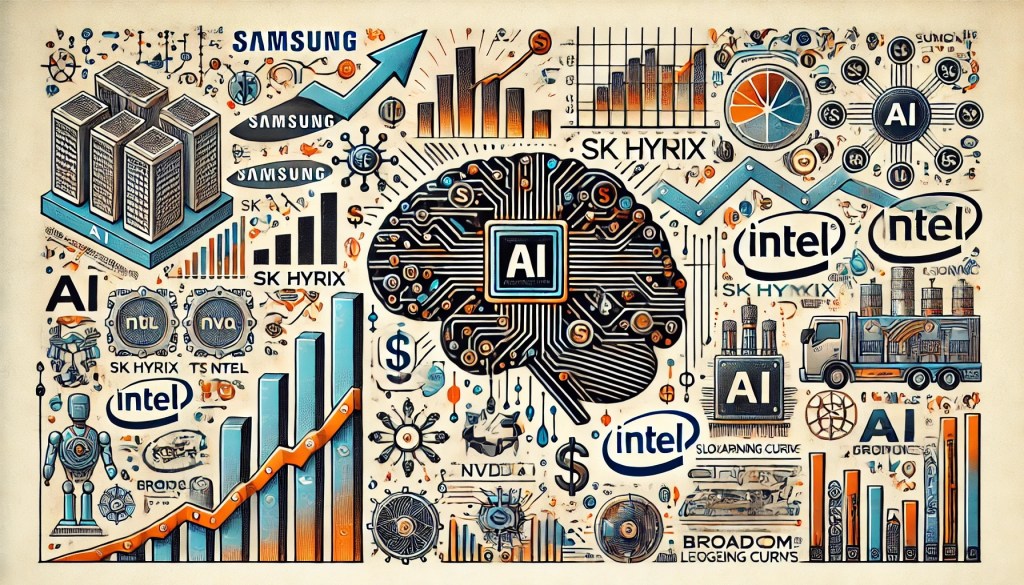
Samsung Electronics’ stock price fell by 10.30%, and SK Hynix dropped by 9.87%. Additionally, companies related to AI power supply, such as content and cable companies, have also recorded significant declines. In the US market, major AI-related companies like NVIDIA, Amazon, and Microsoft have seen their stock prices fall as well.
2. Intel’s Performance and the Profitability Issue in the AI Industry
Intel’s stock price dropped by 26.06%, which also caught attention. Intel CEO Pat Gelsinger stated during their performance announcement that they have not yet achieved complete profitability regarding major AI trends, highlighting the high costs and low profit margins as significant issues.
Moreover, the annual salary for an OpenAI engineer is about 2 billion won, which adds to the concern. With the depletion of significant learning data and the difficulties in achieving future profitability, the challenges continue to mount.
3. Stagnant AI Demand and Delayed Digital Transformation (DX)
The digital transformation (DX), which is crucial for AI adoption, is still ongoing, with many companies working towards it. However, due to economic downturn concerns, it is challenging to make quick decisions on large-scale AI transitions.
On the other hand, the rapid emergence of innovative AI services and the depletion of data necessary for AI learning are also concerning. This depletion could slow down AI learning speeds, potentially hindering technological advancements.
4. Investment Strategies and Future Outlook
Experts emphasize the need to discern between valuable and less valuable AI-related stocks carefully. They suggest avoiding stocks that have risen sharply due to high expectations and focusing on core companies instead. Companies at the center of AI hardware and semiconductor fields, such as NVIDIA, TSMC, and Broadcom, are considered valuable for a strategic approach involving purchasing during price corrections.
There is also growth potential for domestic AI-related equipment and infrastructure companies. Major high-tech companies continue to expand their AI equipment investments, and high-bandwidth memory (HBM) related stocks may see some rebound. AI software companies that pursue a ‘focused strategy’ could maintain growth by providing services to security-conscious government and public institutions and by targeting emerging markets in Southeast Asia.
5. Conclusion
The AI industry faces numerous challenges and growth opportunities. It is essential to monitor technological advancements and market trends carefully while establishing a sound investment strategy. Prioritizing investments in core companies and aiming for efficient growth are crucial. Keeping a close eye on the AI industry’s developments and making informed decisions will be key moving forward.