Bilingual Bedtime Stories: Favorite Tales from Both Countries and Their Cultural Lessons

In the gentle glow of the nightlight, our twin babies, nestled in their cribs, gaze up with eyes wide open, eager for their nightly journey through stories. At ten months old, they are on the cusp of language, absorbing sounds and syllables from the two worlds they were born into. This nightly ritual is more than a lullaby; it’s a bridge between cultures, a tapestry woven from the threads of my Japanese heritage and my wife’s Korean lineage.

Our bedtime tales are a carefully curated collection of folklore and fables from Japan and Korea. Each story is a vessel of cultural lessons, carrying the wisdom of generations and the spirit of our ancestors. The Japanese “Momotaro”, or “Peach Boy”, teaches them about bravery and kindness, while the Korean “Heungbu and Nolbu” imparts the virtues of generosity and the perils of greed.

As I recount the adventures of Momotaro, with his animal friends setting out to vanquish ogres, I can see the sparks of courage light up in our babies’ eyes. My wife’s melodic Korean lulls them into the world of Heungbu, where the swallow brings both a lesson and a reward for kind hearts. These stories, rich with cultural significance, are the roots we plant for our children, grounding them in the heritage of both their mother and father.

We hope that as they grow, the morals and tales from both shores of the East Sea will guide them in becoming citizens of the world, fluent in the language of kindness, courage, and understanding. Our bilingual bedtime stories are more than just a routine; they are the seeds of cultural identity for our little ones, a gift of heritage that they will carry forward into their bright, boundless futures.
Teaching Twins About Their Heritage: Creative ways to introduce them to their roots

Raising twins is a unique adventure, one that comes with twice the laughter and love. For our 10-month-old darlings, born from the union of two rich cultures—Japanese and Korean—introducing them to their heritage is a delightful challenge we embrace wholeheartedly.

Living in Korea, we’re surrounded by the vibrant tapestry of Korean culture, which is part of their daily lives. From the soothing lullabies of ‘Arirang’ to the colorful festivities of Chuseok, our twins are growing up with the rhythms and hues of their Korean ancestry. They’re touched by its traditions, from the simplicity of a hanbok to the festivities of Seollal, the Lunar New Year.

However, it’s equally important to weave the threads of their Japanese heritage into their identities. Despite being miles away from Japan, we find creative ways to imbue our home with the essence of its culture. Japanese folktales become bedtime stories, filled with lessons from ‘Momotaro’ or the bravery of ‘Urashima Taro’. Meals are a time of cultural education, too, with the twins’ first tastes including the subtle flavors of miso soup and the comforting warmth of okayu.

We celebrate Japanese holidays with equal fervor, marking each season with its corresponding festival. When Hina Matsuri rolls around, we display ornamental dolls to wish them happiness and health, and during Tango no Sekku, we fly koinobori flags to celebrate their growth and strength.

Our bilingual lullabies are a testament to our dedication to nurturing their dual identity. While they may not understand the words just yet, the melodies are a gentle reminder of their unique lineage.

The journey of teaching our twins about their heritage is more than just passing down traditions—it’s about instilling in them a sense of belonging to both cultures, a bridge between the land of the morning calm and the island nation with the rising sun. It’s a story of a family, intertwined by two distinct cultures, yet united in love and the joy of exploration.

As they grow, we hope to foster an appreciation for both cultures that shaped them. We look forward to the day when they can navigate the streets of Tokyo with the same ease as the alleys of Seoul, their hearts beating to the drum of their rich, shared heritage.

Motherland Trips: Taking the twins to Japan

As a Japanese living in Korea, my wife and I have always dreamt of taking our twin babies on a journey to my homeland. The excitement of introducing them to the rich culture, delicious cuisine, and breathtaking landscapes of Japan has been on our minds ever since their birth. Yet, as life’s responsibilities took over, we haven’t had the chance to travel abroad with our little ones just yet. But with each passing day, the dream grows stronger, and we hope that next year will finally be the year our adventure begins.

The thought of embarking on this journey fills us with anticipation. Our twins are now at that age where their senses are ever-curious, and we can only imagine the wonder in their eyes as they experience the beauty of Japan for the first time. From the bustling streets of Tokyo to the tranquil temples in Kyoto, Japan promises a diverse range of experiences that will leave lasting impressions on our family.

One of the things I’m most excited about is introducing our children to the vibrant traditions of my homeland. The festivals, like cherry blossom viewing in spring and festivals in traditional yukatas during summer, will be unforgettable experiences for them. They’ll get to taste the delicious flavors of Japanese cuisine, from sushi and ramen to takoyaki and tempura, and they might even develop a taste for green tea and mochi.

Exploring the natural beauty of Japan will also be a highlight of our trip. The serene gardens, majestic mountains, and pristine beaches offer a contrast to the bustling city life. We’ll take our twins on hikes through lush forests and show them the stunning views from Mount Fuji. A visit to an onsen (hot spring) will be a chance for relaxation and a cultural experience rolled into one.

Of course, we understand that traveling with twins won’t be without its challenges. Packing for two babies, ensuring their comfort on long flights, and managing their schedules in a foreign country will be an adventure in itself. But the thought of seeing our children’s faces light up as they discover new things is motivation enough.

As we eagerly look forward to next year, we’re making plans, creating itineraries, and imagining the memories we’ll make. The journey will be more than a vacation; it will be a connection to our roots and an opportunity for our twins to embrace their multicultural heritage.

Our Motherland Trip to Japan is a dream we’re determined to turn into reality. It’s a chance for our family to bond, learn, and grow together. We can’t wait to see what adventures await us in the land of the rising sun, and we’re counting down the days until we can finally say, “Konnichiwa, Japan!”

So, stay tuned for our upcoming adventure as we embark on this incredible journey with our twins. Until then, the anticipation builds, and our hearts are set on Japan.

I hope you find this essay enjoyable and reflective of your sentiments. If you’d like any further edits or have specific details to include, please let me know!

The Cultural Dashboard: Deciphering Vehicle Surveillance Lexicon Globally

Imagine driving through the bustling streets of New York, Tokyo, or Seoul and you’ll notice one common thread in the tapestry of urban transport—dashboard cameras, or as they’re known locally, ‘Drive Recorders’ and ‘Black Boxes’. To the international business person, these aren’t just gadgets; they’re a vantage point into how culture shapes technology and its adoption.

In the United States, the term ‘dashboard cameras’ evokes a sense of security and surveillance, a co-pilot for the litigious journeys on American roads. They are the unsung heroes in a court of law, providing evidence where memory fails.

Cross the Pacific to Japan, and the ‘ドライブレコーダー’ (Drive Recorder) not only surveils but also narrates the story of the drive. It’s a reflection of Japan’s deep-rooted affinity for technology that complements their disciplined driving etiquette. Here, it’s less about surveillance and more about preserving the harmony on the road.

Venture into Korea, and the ‘블랙박스’ (Black Box) becomes an essential co-driver, echoing the aviation term for flight data recorders. It’s a cultural insight into the Korean psyche—preparation and documentation are key. In the fast-paced, hyper-connected streets of Seoul, a Black Box is your testament to truth in a land where digital proof is king.

For the international businessperson, these nuances are critical. They signify more than mere linguistic differences; they embody the ethos of each market. The US’s emphasis on legality, Japan’s on harmony, and Korea’s on preparedness must play into how these products are marketed and adapted for each region.

Understanding these subtleties informs branding strategies. In the US, market the camera as a guardian of personal interest. In Japan, it’s an extension of the vehicle’s identity, capturing the journey’s essence. And in Korea, it’s a bastion of the driver’s rights, an unblinking witness in a digital age.

To thrive in international business, one must appreciate that a product is more than its function—it’s a narrative woven into the fabric of culture. For dashboard cameras, they are not just lenses capturing road events; they are storytellers, guardians, and witnesses. Understanding this can be the difference between a product that fits in and one that stands out.

Understanding the Use of ‘San’ in Japanese Names: A Cultural Insight

In Japanese, appending ‘san’ to a person’s name is a way to express politeness, akin to saying Mr. or Ms. in English. This form of address is deeply rooted in Japanese culture and is indicative of the respect ingrained within the language. It’s comparable to honorifics in other Asian languages, such as ‘ssi(씨)’ or ‘nim(님)’ in Korean and ‘xiānsheng(先生)’ in Chinese, which are used to show respect and politeness.

As a Japanese national working for an American company in South Korea, I’ve been pleasantly surprised to find that ‘san’ is widely recognized even outside of Japan. It’s a piece of linguistic etiquette that has crossed borders, demonstrating the influence of Japanese culture globally.

To illustrate, let’s take a common Japanese name: ‘Ohtani’. When addressing this individual respectfully, you would say ‘Ohtani-san’. This signifies a level of politeness and can be used in almost any context, whether you’re speaking to a colleague, a friend in a more formal setting, or even a stranger. It’s a simple yet profound way of acknowledging someone with courtesy.

For those not familiar with Japanese, understanding the nuance of ‘san’ is a window into the subtlety and respect of Japanese communication. It’s a small linguistic token, but it carries the weight of cultural significance and politeness.

Marrying Across Cultures: Personal stories and lessons learned from a Japanese-Korean marriage.

Marrying someone from a different cultural background can be a journey filled with unique challenges and enriching experiences. As a Japanese individual living in Korea, my marriage to a Korean woman has been a tapestry woven with both the threads of struggle and understanding.

Our union is a daily negotiation of norms and customs where the subtleties of language and tradition often dance in delicate balance. The birth of our twin babies added a new dimension to our multicultural family, bringing forth the question of identity and heritage in their upbringing.

Raising our children has been an enlightening endeavor, as we strive to instill in them a sense of dual belonging. We celebrate traditional festivals from both cultures, ensuring that the twins appreciate the richness of their mixed heritage. Our kitchen is an aromatic testament to this blend, with the flavors of kimchi and miso often mingling in harmony.

Through our journey, we’ve learned that patience and open communication are the cornerstones of navigating a cross-cultural marriage. It’s about embracing differences and building a family culture that is uniquely ours. Our love story is a reminder that beyond the cultural divide, the universal language of love and understanding can create a bond that is unbreakable.

The Art of Precision in a Multicultural Business Landscape

As a Japanese professional immersed in the vibrant complexity of an international enterprise, I’ve learned that cultural and linguistic intricacies are more than just fascinating—they’re critical to success. The way we write addresses, the sequence of dates, and even the order of our names are not merely administrative details but reflections of our cultural identity.

From the bustling streets of Tokyo to the skyscrapers of New York, the format in which an address is written can tell you a lot about local customs. In Japan, we begin with the country and narrow down to the specific residence, a style that mirrors the Eastern collective mindset. This approach, while logical within its own context, can cause confusion when interpreted through a Western lens, where the individual’s address leads the way.

Dates are another common stumbling block in cross-cultural communication. A document named “2023.11.07” seems straightforward but is a riddle when global partners are involved. To a Western colleague, this might mean July 11th, but to me, it represents November 7th. It took one critical meeting, scheduled on an ambiguous date, for me to realize the gravity of these differences. In the multicultural world of business, the lack of a clear, common standard for dates can lead to missed deadlines and bewildered partners.

I have learned the hard way that even the most diligent professional can trip over these cultural nuances. The naming of files, an act I once considered trivial, suddenly took center stage when a project deadline was misunderstood. The confusion lay in the interpretation of the date, a simple yet profound difference between East and West that had far-reaching consequences for our project timeline.

And it’s not just numbers on a page. The order in which we present our names can be just as perplexing to our international counterparts. In the East, the family name proudly comes first, a testament to our cultural emphasis on lineage and legacy. But in the West, where the given name takes precedence, this can lead to a jarring reversal, often requiring correction and clarification in business documents and communications.

These experiences have been enlightening, to say the least. They have taught me the importance of explicit clarity in our global discourse. Whether it’s adopting the ISO standard date format for unambiguous communication, or clearly indicating the structure of names on business cards and email signatures, each step towards clarity is a step towards better understanding.

In essence, my journey has been about embracing the diversity that defines our world while finding ways to create harmony amid difference. It’s about recognizing that our way of doing things is just one among many and that in the grand tapestry of global business, every thread has its unique place.

This expanded essay weaves in additional cultural elements based on personal experience, illustrating the complexities and the potential for misunderstanding inherent in international business, while reinforcing the importance of adopting clear communication standards.

Festivals and Traditions: Celebrating Japanese and Korean Holidays in a Bicultural Household

When two hearts from different backgrounds unite, they bring along a tapestry of traditions, fables, and festivities. As a Japanese individual living in Korea, married to a wonderful Korean woman, our household is a living testament to this vibrant fusion. With the arrival of our twin babies, the blend of Japanese and Korean cultures has taken on an even richer hue, as we strive to offer them the best of both worlds.

**Golden Threads from Japan**

Being Japanese, festivals like the ‘Tanabata’ or Star Festival have a special place in my heart. It’s a story of star-crossed lovers, represented by the stars Vega and Altair, who are allowed to meet only once a year. As July approaches, our home is adorned with colorful ‘tanzaku’ – wish papers. The twins, though young, already show a gleam of excitement as they scribble on these papers.

The ‘Obon’ festival, another integral part of Japanese culture, becomes a time for family, where we honor the spirits of our ancestors. Lanterns light up our home, and the scent of incense fills the air, creating a bridge between the past and the present.

**Korean Tapestries of Tradition**

Korea, with its rich history and traditions, offers an equally captivating array of festivals. ‘Chuseok’, often likened to Thanksgiving, is a time for gratitude and family reunions. Dressed in the traditional ‘hanbok’, our twins look like little ambassadors of Korean culture. We prepare songpyeon (rice cakes) together, and I must admit, my wife’s recipe is to die for!

Then there’s ‘Seollal’, the Lunar New Year. It’s more than just a day; it’s an emotion. Exchanging formal bows, playing traditional games, and the sheer joy of sharing ‘tteokguk’ (rice cake soup) – these moments are etched in gold.

**Weaving the Tapestry Together**

In our bicultural household, there is no ‘either-or.’ It’s always about ‘and’. We celebrate both ‘Setsubun’ (Japanese Bean-Throwing Festival) and ‘Dano’ (Korean spring festival) with equal fervor. The sounds of laughter and traditional music, the aroma of festive foods, and the visual spectacle of traditional dresses – all merge to create a harmonious blend.

What’s wonderful is how these celebrations teach our twins about unity in diversity. They learn that while borders might define nations, love knows no boundaries. They are growing up understanding that traditions, irrespective of their origin, essentially celebrate the same human emotions – love, gratitude, joy, and hope.

In conclusion, our bicultural household is a dance of colors, sounds, and emotions – a dance that celebrates the best of both Japanese and Korean worlds. As our twins grow, we hope to instill in them a love for both cultures, teaching them to cherish and uphold the beautiful traditions that define their unique heritage.

**Understanding Language Development in Bilingual Children**: A study on how your twins are picking up both Japanese and Korean.

As a Japanese individual who’s made Korea home, I’ve often marveled at the rich tapestry of linguistic diversity that my family’s life represents. My wife, a native Korean, and I have brought into the world twin bundles of joy who are now 10 months old. These days, we are witness to their first attempts at vocalizing thoughts, a fascinating period of murmurings and sounds.

As any new parent will tell you, observing the milestones in a child’s growth is nothing short of magical. For our twins, this journey takes on an added layer of complexity, given that they are immersed in both Japanese and Korean. Their babblings, a mix of random sounds and imitations, are the building blocks of speech and language. As I hear them murmur, I often find myself wondering: Are they picking up sounds from Japanese, Korean, or both?

Linguists assert that children raised in bilingual environments have a unique advantage. Their neural pathways adapt to accommodate two languages, often giving them greater cognitive flexibility in the long run. While some parents worry about potential confusion or delay in speech development, most studies suggest that bilingual children catch up to their monolingual peers by school age.

Being surrounded by both languages daily, our twins are exposed to a multitude of sounds, tones, and rhythms specific to Japanese and Korean. Their tiny brains are hard at work distinguishing, processing, and attempting to reproduce these sounds. Even in their incoherent murmurs, there might be hints of this bilingual foundation being laid.

For now, their vocalizations might sound like mere baby talk. But soon, these will transform into discernible words, and eventually into full-fledged sentences in both Japanese and Korean. As parents, our role is to provide a supportive environment where both languages can thrive. This involves conversing with them in our native tongues, singing bilingual lullabies, and exposing them to stories from both cultures.

As our twins grow older, I anticipate challenges – instances where they might mix both languages or prefer one over the other. But these are mere steps in their bilingual journey. The end reward? Two culturally rich languages that will open doors to a world of opportunities and understanding.

To all parents raising bilingual children, I say: Embrace the journey. Cherish every murmur, every mixed-up word, and every sentence. For in these moments, you’re witnessing the incredible adaptability and potential of the human brain.

In our home, Japanese and Korean coexist, not just as languages, but as bridges to our ancestral roots and stories. Through our twins, we hope to pass on this legacy, one word at a time.

“The Joys and Challenges of Raising Bicultural Twins”: An insight into the ups and downs of parenting twins from two cultures.

As a Japanese living in Korea, I never imagined that my life would take such an exciting and enriching turn. My wife is Korean, and together, we are navigating the incredible journey of raising bicultural twins. Our babies are now 10 months old, and every day is an adventure filled with both joys and challenges.

One of the most delightful aspects of raising bicultural twins is the exposure to diverse traditions and customs. Our home is a melting pot of Japanese and Korean traditions, and it’s heartwarming to see our little ones growing up with a deep appreciation for both cultures. They learn to bow to their elders with respect, just as they enjoy the vibrant colors and flavors of Korean cuisine. It’s a beautiful blend of heritage that makes our family unique.

However, it’s not all smooth sailing. Communication can be a bit tricky, as my wife and I speak different languages at home. While we are both fluent in each other’s languages, deciding on which one to use with the twins can be a dilemma. We want them to be proficient in both Japanese and Korean, but we also don’t want them to feel overwhelmed. Finding the right balance is a constant challenge.

Another aspect that requires extra attention is the cultural differences in parenting styles. In Japan, there is an emphasis on structure and discipline, while Korean parenting often involves a strong focus on academic success. Balancing these approaches can be tough, as we want our twins to have the best of both worlds without feeling pressured.

One thing that unites our family is the sheer joy of watching our babies grow and discover the world. Their laughter and curiosity transcend cultural boundaries, reminding us that love and happiness are universal languages. We cherish the moments when they try their first solid foods, take their first steps, or say their first words, regardless of the language they speak.

Raising bicultural twins is an ongoing learning experience, and we are grateful for the opportunity to provide them with a rich and diverse upbringing. We know that challenges will arise along the way, but the love and unity in our family will always guide us. Our twins are a beautiful blend of two cultures, and we can’t wait to see how they shape their own unique identities in the years to come.

In the end, “The Joys and Challenges of Raising Bicultural Twins” is a title that perfectly encapsulates our parenting journey. It’s a journey filled with love, laughter, and the promise of a bright future for our precious twins.

The Joyful Recovery of My Twin Babies

Having children, especially twins, is a roller-coaster ride filled with highs and lows. Just 10 months old, my twins are a delightful handful. Their giggles, curious eyes, and the way they explore the world around them constantly fill my days with joy and wonder. However, like any parent, the lows hit hard when they fall sick.

Last week, a wave of anxiety washed over my household as both babies caught a cold. Anyone familiar with the vulnerability of infants knows the deep worry that can gnaw at a parent’s heart when their child is unwell. With their tiny noses blocked and their usual spirited energy replaced by fatigue, the house seemed to be cloaked in an uneasy silence, a stark contrast to the regular baby chatter and laughter.

But, as with all things in life, this too was a phase, and thankfully, a short-lived one. Today marked a significant turnaround in their health. I noticed it immediately when I walked into their room and was greeted with those familiar bright eyes and heartwarming smiles. The infectious laughter, which had taken a brief hiatus, echoed through our home once again, lifting our spirits and filling the air with renewed hope and relief. Both my wife and I felt a weight lifted off our shoulders, and the joy we felt seeing our little ones back to their lively selves was incomparable.

It’s moments like these that remind us of the fragility of life, the importance of cherishing every moment, and the indescribable happiness that the laughter of our loved ones can bring.

A Celebration of Beginnings: Twins at a Colleague’s Wedding

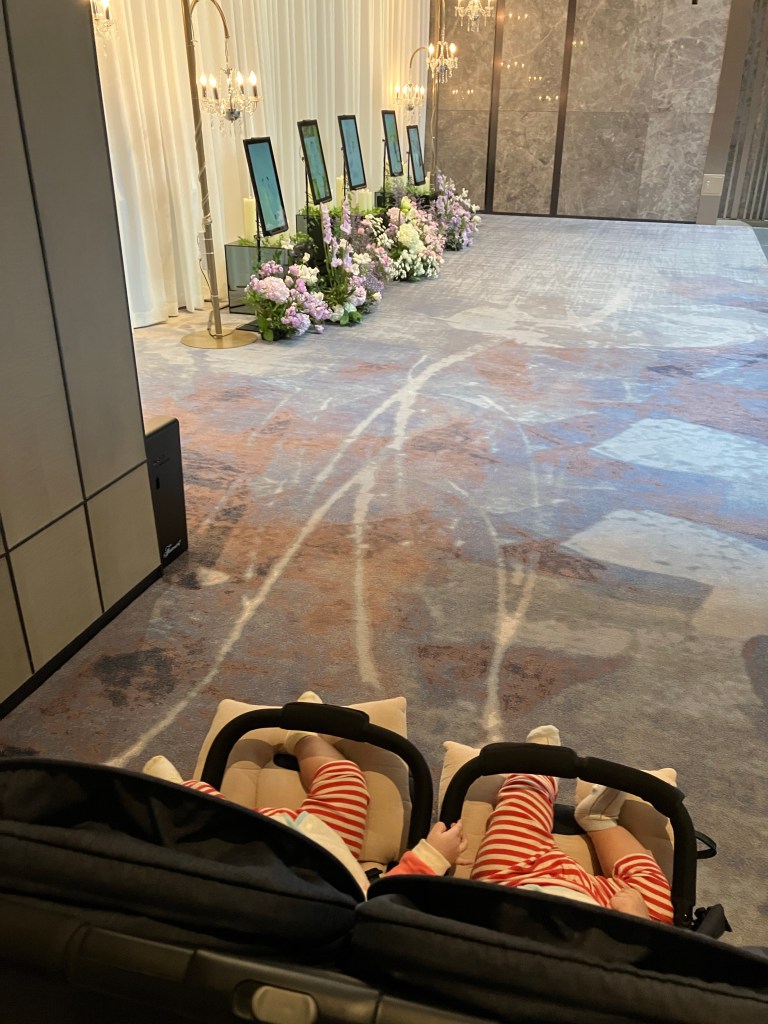
Attending a wedding is always a poignant reminder of the journey that love charts, but attending one with our 10-month-old twins in tow added layers of warmth and complexity to the celebration. The occasion was the union of dear colleague of mine, and our little family was there to witness their joyous commencement into married life.

There was a certain charm in the air that day, a blend of sophistication and heartfelt joy as we navigated the festivity with our babies. The venue, I recall, was breathtaking – dressed in elegant florals and soft, ambient lighting that seemed to promise new beginnings not just for the couple, but for all who gathered in support.

The feast laid out was nothing short of spectacular, a full-course that beckoned us to indulge in the culinary delights. However, as my wife and I alternated between caring for our little ones and trying to savor the meal, the proverbial village manifested in the kindest of ways. Our colleagues, with their intuitive gestures and nurturing spirits, took turns holding our twins, allowing us to partake in the celebration more fully. This generosity was a vivid illustration of the adage, “It takes a village to raise a child,” and never had it felt more tangible and poignant.

This simple yet profound kindness has stayed with me, compelling me to plan a token of gratitude for these colleagues, perhaps a lunch treat in the following week. It was an affirmation of the solidarity and support that can make life’s most demanding moments beautiful and memorable.

As the evening wound down, it was clear that the event was more than just a display of commitment between two individuals. It was a showcase of the collective love and support that makes such a journey possible. The sincere help from our colleagues was a gentle reminder that while love can be found in grand romantic gestures, its true essence often shines through in the quiet, selfless acts we offer each other. And as we gathered our things, our twins, now content in the arms of our extended work family, served as the perfect emblem of the day’s purest love and camaraderie.